


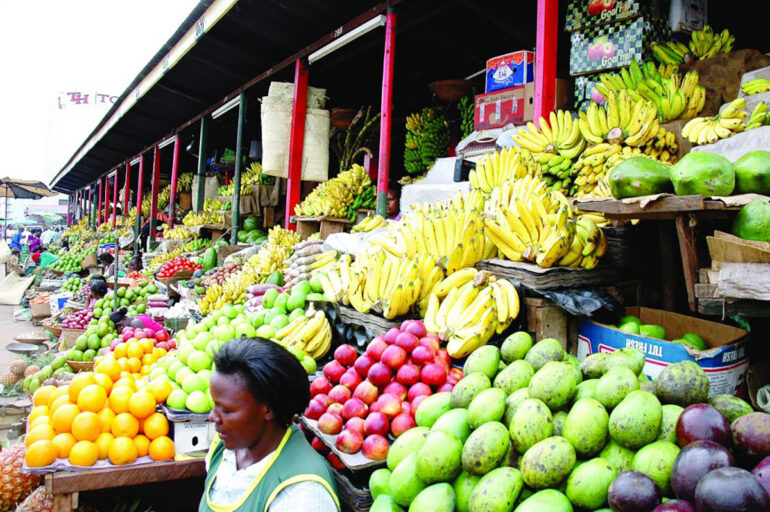
Uganda’s annual headline inflation has eased to 3.8% in July 2025, down slightly from 3.9% recorded in June, according to the latest figures from the Uganda Bureau of Statistics (UBOS). This decline reflects a combination of declining food prices and stable energy costs, offering some relief to consumers battling high living expenses in recent months. The UBOS report for July, released last week, indicates that the annual headline inflation, as measured by the Consumer Price Index (CPI) for the 12 months to July 2025, stood at 3.8%. This moderation comes as the cost of several key food items declined, driving down overall inflationary pressures. “Among other things, annual price reductions were noted for Irish potatoes, fresh leafy vegetables, tomatoes, beans, and matooke,” the report notes. Samuel Echoku, the Head of Macro Statistics at UBOS, said the decline reflects improved supply conditions for key food items and stability in the broader economy. “The easing of headline inflation is largely driven by the fall in food prices, particularly for matooke, tomatoes, and Irish potatoes. This indicates that supply-side factors are improving, which is good for household consumption,†Echoku said. The latest data reveals significant price declines in some major food categories. Tomato prices plunged by 8.1% in July, a stark contrast to the 0.9% increase recorded in June. Fresh milk also saw a 3.6% price reduction, while matooke prices dropped by an impressive 35.3%. Irish potato prices fell by 4.6%, reflecting increased supply in key producing regions. Despite these decreases, some staples recorded price hikes. Groundnuts, maize grain, and Nile perch prices rose slightly, indicating continued price pressures in some segments of the food basket. On a month-to-month comparison, July recorded 0.1% headline inflation, while monthly core inflation, which excludes food crops, fuel, electricity, and metered water, stood at 0.2%. The Energy, Fuel, and Utilities (EFU) index revealed a mixed trend. Electricity prices decreased by 5.7% in June but rose by 4.3% in July, largely reflecting adjustments in tariffs and fuel costs. Liquid energy fuels also declined, helping offset some of the increases in other categories. However, the cost of charcoal increased from 4.6% to 5.5%, and water charges rose from 1.9% to 2.3% between June and July, pointing to continued upward pressure on household utility expenses. Inflation trends varied across the country. Masaka registered the highest inflation at 5.1%, though this marked a slight drop from 5.4% in June. Kampala High-Income areas recorded 4.9%, up from 4.8%, while Mbale saw the lowest inflation at just 0.2%, down from 0.7%. These regional variations reflect differences in local food production, transport costs, and utility pricing. While the decline from 3.9% to 3.8% may seem modest, experts say it signals a period of price stability, which could help consumers better manage their budgets.
“This is a positive sign for the economy. It means household purchasing power is improving slightly, and if this trend continues, we are likely to see increased consumer confidence,†Echoku added.
For policymakers, easing inflation provides a cushion to maintain accommodative monetary policies while monitoring external shocks. The Bank of Uganda may interpret the slowing inflation as a sign to maintain or slightly adjust interest rates to balance growth with price stability. Economists note that if this trend continues, it could boost consumer confidence, increase household purchasing power, and support economic activity, particularly in retail and agriculture-dependent sectors. Despite the decline, UBOS warns that volatile global fuel prices and climatic disruptions could reverse gains in the coming months. Sustained food supply and stable energy costs will be critical in keeping inflation within manageable levels.
Uganda’s headline inflation down to 3.8% in July

Last updated: