




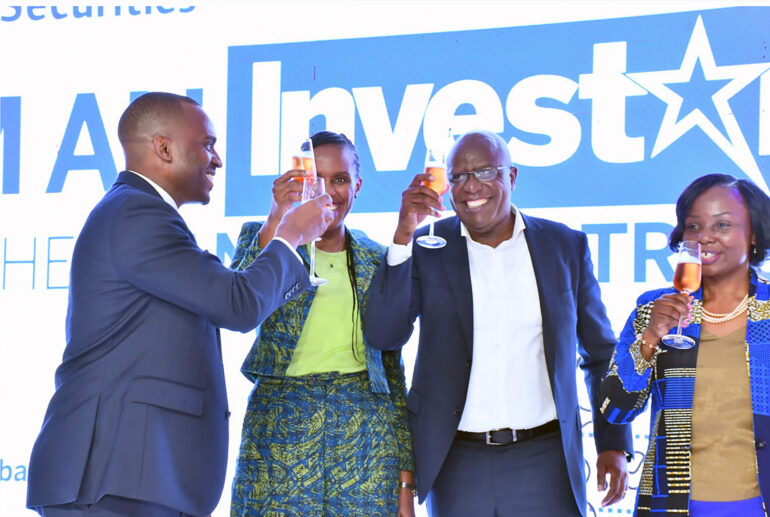
In a brief to customers dated January 26, Grace Semakula, the CEO of SBG Securities Uganda Limited, says 2025 “was a strong year” for the company.
The brief adds that SBG Securities has now become the country’s third-largest Collective Investment Scheme manager with assets under management hitting UGX 540 billion by end of 2025.
The achievement, which earned the firm CIS Manager of the Year at the Capital Markets Authority awards, reflects something bigger: Uganda’s unit trust industry is finally gaining momentum after years of sluggish growth.
SBG’s addition of 4,000 new clients and market share growth exceeding 8% tells a story that extends across the sector. The industry has crossed UGX 5.2 trillion in total assets, representing a remarkable 63% year-on-year surge.
From a modest UGX 157 billion in 2019, this growth trajectory suggests Ugandans are slowly warming to professionally managed investments.
But size alone doesn’t tell the full story. What makes unit trusts attractive right now is performance. Money market and balanced funds are delivering annual yields between 11.5% and 13.2%, comfortably outpacing inflation hovering around 4%.
With portfolios heavily weighted toward government securities – typically 60-75% of holdings – these funds offer both security and returns that make traditional bank savings accounts look increasingly unappealing.
The market has also evolved beyond just a few players. Heavyweights like UAP Old Mutual, Sanlam, and ICEA LION dominate, with UAP alone managing over UGX 2.8 trillion, new entrants like XENO Investment Management are disrupting the space with mobile-app-based platforms that allow investments starting as low as UGX 10,000.
The government’s recent launch of the Okusevinga Money Market Unit Trust Scheme pilot signals official recognition of these vehicles as tools for financial inclusion.
Yet, significant obstacles remain. Despite impressive growth numbers, the industry’s total assets represent just 2.3% of GDP – a fraction of what Kenya’s more mature market has achieved.
With 148,843 funded accounts against a population of almost 50 million, penetration remains shallow.
The challenges are structural. Low financial literacy tops the list. Most Ugandans still don’t understand pooled, risk-based investing, often confusing unit trusts with bank deposits and expecting guaranteed returns.
The shallow capital markets compound the problem. With fewer than 20 companies listed on the Uganda Securities Exchange, fund managers struggle to create diversified portfolios, forcing heavy concentration in government securities. While this ensures stability, it limits growth potential.
Minimum investment thresholds, though lowered by some innovators, remain prohibitive for many. Management fees, while regulated, are still perceived as high.
And there’s stiff competition from Treasury Bills offering double-digit returns directly from the Bank of Uganda, drawing liquidity away from unit trusts.
The industry stands at a crossroads. The demographic opportunity is real – Uganda’s young population represents a massive potential investor base. Mobile money penetration provides proven infrastructure for financial inclusion that could be leveraged for micro-investments.
The NSSF’s entry into the market brings legitimacy and public awareness.
But converting potential into reality requires more than product innovation. It demands sustained financial literacy campaigns, deeper capital markets, and building trust in an investment culture still dominated by informal savings and tangible assets. SBG Securities’ success shows what’s possible.
The question is whether the industry can scale these wins across Uganda’s 50 million population.