




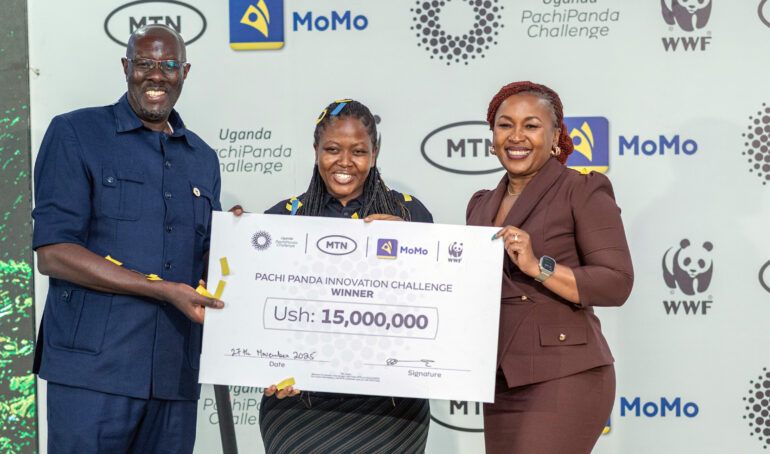
MTN Uganda, in partnership with WWF Uganda, will this weekend send FarmGate Digital, the winners of the inaugural Pachi Panda Innovation Challenge, to South Africa for the continental finals, where it will compete with innovators from Zambia, Nigeria, Cameroon and South Africa.
The startup received UGX15 million for its national victory as recognition of a solution targeting one of Uganda’s least visible yet increasingly urgent environmental pressures.
FarmGate Digital is a food preservation initiative that aims to reduce post-harvest losses.
Ruth Kyobutungi, the organisation’s founder, says an estimated 30 to 40 percent of fruits and vegetables are lost after harvest in Uganda.”
“In Kampala alone, more than 1,000 tonnes of food are discarded every week from major markets, where rotting organic waste releases methane, a potent greenhouse gas,” she says.
The organisation intervenes where losses are most acute, after harvest, when weak coordination, limited storage and opaque pricing systems turn edible food into waste and lock farmers into distress sales.
Kyobutungi describes the solution as “a market coordination and food preservation system that connects pricing, quality and storage into one operating model,” designed to work within existing food systems rather than replace them.
Rather than positioning itself as a standalone mobile application, FarmGate is being built as a wider market system that integrates digital tools with human support and physical infrastructure.
Alongside a smartphone application currently under development, the platform will include a USSD interface, enabling farmers with basic feature phones to participate using simple codes.
Trained field agents will provide on the ground support for farmers who need assistance, while a dedicated website will connect buyers, partners and institutions to the ecosystem.
For now, the model is being tested through simulations and a web based backend managed by people, allowing the system to be refined before significant capital is deployed.
“We track what food exists, its quality and how long it can remain edible, then match it to buyers who can use it in time,” Kyobutungi explains. “Prices adjust based on freshness and demand, rather than guesswork.”
Farmers share basic information about their harvest, including crop type, volume, harvest timing and storage conditions, via smartphone, USSD or with help from an agent.
The system assigns a freshness score, dynamically adjusts prices as time passes, and recommends the most viable bids to farmers.
Unlike digital platforms that simply list prices or connect buyers and sellers, FarmGate integrates market data with physical storage solutions.
These include short term, solar powered cold storage and redistribution pathways that redirect food nearing spoilage to secondary markets, processors or institutions instead of landfills.
“We use data to coordinate timing, quality, pricing and storage decisions across farmers, buyers and markets,” she says, noting that the system is intentionally built to function across smartphones, feature phones and agent networks.
As FarmGate prepares for the continental finals in South Africa, Kyobutungi says the model is designed to scale without erasing local realities.
“African food systems are highly local,” she says. “Our strength is not assuming uniformity, but building something that adapts.”
By focusing on waste rather than output, FarmGate reflects a broader shift in African climate innovation, one that prioritises redesigning how food systems function, improving incomes, reducing emissions and strengthening urban food security, rather than simply digitising existing inefficiencies.
MTN Group launched the Pachi Panda Innovation Challenge in Zambia in 2022, aligned with MTN’s now beyond Ambition 2025 strategy, which centres on digital innovation, sustainability and shared value creation.