



The Monetary Policy Committee (MPC) of the Bank of Uganda (BoU) has decided to maintain the Central Bank Rate (CBR) at 9.75%, signalling a cautious yet supportive approach to economic growth amid on-going global uncertainty.
The Committee assessed that the current policy stance remains appropriate to foster economic activity while keeping inflation on a stable path toward the medium-term target of 5%.
Inflation has remained consistently below the target, reflecting the impact of prudent monetary policy, coordination with fiscal measures, a stable exchange rate, declining global inflationary pressures, and favourable domestic food and energy prices.
Over the twelve months to January 2026, annual headline inflation averaged 3.5%, while core inflation averaged 3.8%. In January, headline inflation edged up slightly to 3.2% from 3.1% in December 2025, influenced by modest increases in some core components, partly offset by a decline in food crop inflation.
Core inflation rose to 3.3% from 3.1%, mainly due to higher services inflation, particularly in passenger air transport.
Meanwhile, food crop inflation moderated to 3.0% in January, down from 4.4% in December, supported by favourable weather conditions, while Energy, Fuel, and Utilities (EFU) inflation rose modestly to 1.7% from 1.4% due to slight increases in firewood prices.
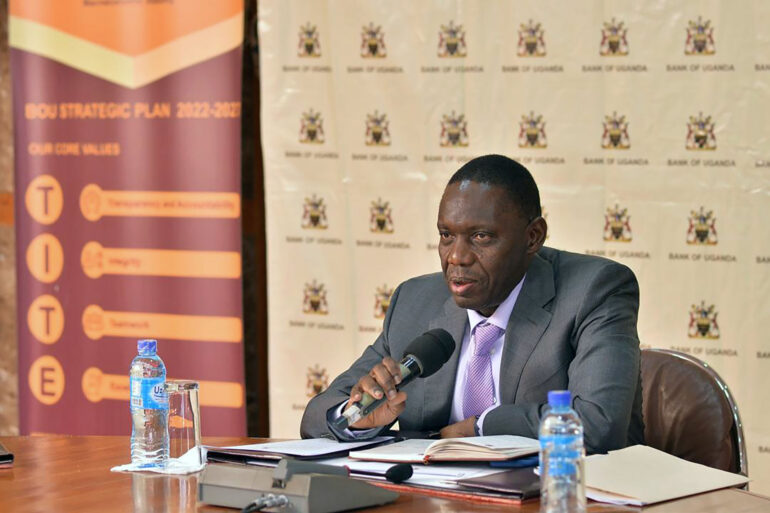
Commenting on the policy decision, Prof. Augustus Nuwagaba, the BoU Deputy Governor, said that keeping the CBR steady was a prudent move under the current conditions.
“Keeping the policy rate unchanged helps to stabilise expectations in the economy. With inflation below target, there is room to support growth without creating price pressures, especially when global risks remain high,” he said.
The BoU’s decision reflects a balanced approach: ensuring price stability while supporting socio-economic transformation, smoothing economic fluctuations, and fostering conditions for long-term development.
With careful monitoring of domestic and global risks, Uganda’s monetary policy continues to navigate a path that supports growth without compromising financial stability.
The inflation outlook has been revised slightly downward compared to the November 2025 forecast, reflecting the effects of a modest appreciation of the exchange rate and lower international oil and food prices.
Inflation is projected to remain slightly below target in 2026, within the range of 3.8% to 4.3%, before stabilising around the 5% target over the medium term.
This trajectory is supported by continued prudent monetary policy, stable exchange rate conditions, and moderating global commodity prices.
However, risks to the inflation outlook remain elevated. On the upside, stronger-than-expected domestic demand driven by a positive output gap and expansionary fiscal policy could raise price pressures.
Additional risks include adverse weather conditions affecting agricultural output, escalating geopolitical tensions disrupting global supply chains, and a persistently depreciated exchange rate.
On the downside, weaker global growth, trade-related shocks, and a sharper-than-expected slowdown in domestic economic activity could push inflation below target, while falling commodity prices may have disinflationary effects.
Economic activity in Uganda remained steady during the first three quarters of 2025, with average growth of 6.3%, largely supported by final consumption expenditure.
Government consumption expanded by 22.8%, while household consumption grew by 14.2%, contributing to overall stability.
High-frequency indicators suggest that economic activity strengthened in the quarter to December 2025, and growth for FY2025/26 is projected in the range of 6.5% to 7.0%.
Over the medium term, growth is expected to rise to an average of around 8%, driven by accelerated public investment, oil-related and infrastructure developments, continued private sector activity, and improved global economic conditions.