




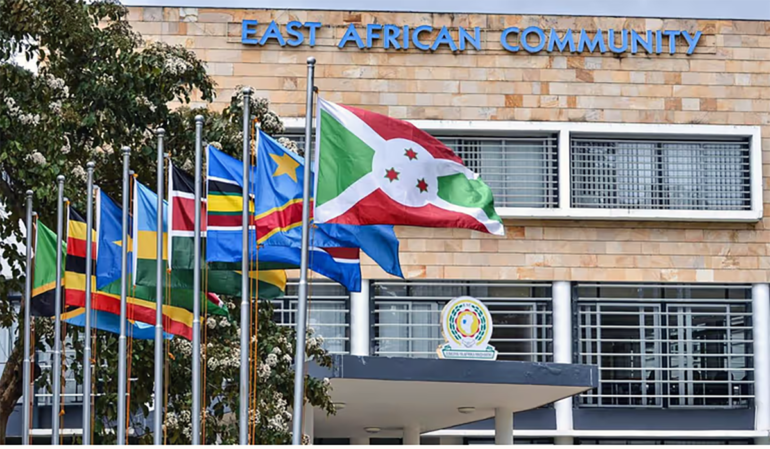
The East African Community (EAC) is currently navigating its most significant financial storm since its re-establishment, with a staggering $89.37 million funding shortfall threatening to paralyze the eight-nation bloc.
Kenya’s President William Ruto, the current chair, has called for an emergency summit on March 7 in Arusha, Tanzania, to address the crisis and prevent an institutional collapse that mirrors the 1977 dissolution of the original pact.
As a cornerstone of the regional agenda, Uganda finds itself in a precarious position, with arrears amounting to more than $1 million. While only Kenya and Tanzania were fully up to date with their $7 million annual contributions for the 2025–2026 financial year as of January 31, 2026, Uganda has historically been among the less consistent payers.
Only 38 % of the approved budget had been funded by early February, 2026.
The current paralysis of the East African Legislative Assembly (EALA) and the East African Court of Justice (EACJ) – both currently unable to function due to lack of funds – directly impacts Ugandan interests.
For the Ugandan business community, the stakes are high. Uganda maintains strong trade surpluses with the DRC ($210.7 million) and South Sudan ($104.4 million), yet it faces a widening trade deficit with Tanzania.
The funding crisis threatens the very infrastructure that facilitates this trade. Key initiatives, such as the EAC Customs Bond recently rolled out by the Uganda Revenue Authority in January 2026 to ease regional movement, depend on a stable and funded Secretariat to resolve non-tariff barriers and coordinate digital systems.
According to a report published by the Business Insider Africa, the crisis is the result of years of mounting arrears from partner states:
- January 31, 2026: Arrears peak at $89.37 million, with some member states—notably the DRC, Burundi, and South Sudan—owing tens of millions.
- February 17, 2026: President Ruto formally convenes the emergency summit after reports that institutions have run out of money for essential operations.
- March 7, 2026: Scheduled summit in Arusha to debate a “new funding formula” to replace the current equal-share model.
Where is a Sustainable Formula?
The primary point of contention for the upcoming summit is the EAC financing model. Currently, each member state is expected to pay an equal share regardless of economic size.
Critics argue this model fails to reflect the different economic capacities of members like the DRC compared to Kenya or Uganda.
For Uganda, the summit offers a chance to push for a more equitable system that ensures long-term stability. Without a resolution, analysts warn that the “integration project” itself is at risk, with institutional trust eroding as treaty obligations go unenforced.
As we look toward the Arusha summit, the question for Kampala is no longer just about the money; it is about whether the political will exists to save the EAC from a repeat of its 1977 collapse.