




There is a quiet crisis in Uganda’s classrooms. Every month, thousands of schoolgirls stay home – not because they lack ambition or ability, but because they lack something as basic as a sanitary pad.
The result is stark: up to five missed school days per month, compounding into lost learning, dented confidence, and, for too many girls, an early exit from education altogether.
NCBA Bank Uganda has decided to do something about it, as Pedson Mumbere reports.
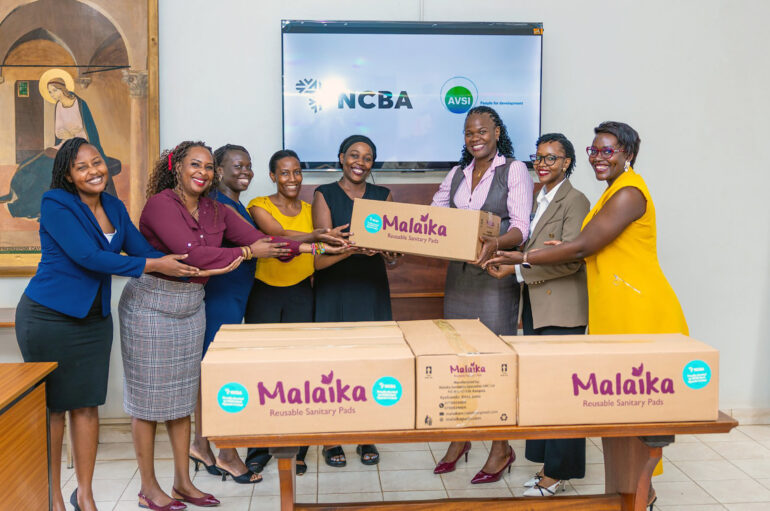
In a partnership with AVSI – one of Uganda’s most experienced development organisations – the bank has procured and distributed 1,500 packs of reusable sanitary pads to schoolgirls in low-income communities.
The effort raised UGX 18.5 million, drawn from both staff contributions and institutional funding under the bank’s sustainability platform, ‘Change the Story.’
The choice of reusable pads is deliberate: they last months when properly maintained, easing the financial burden on families while generating less waste than disposable alternatives.
The numbers are modest relative to the scale of the problem. But the intent is clear, and the execution is grounded – AVSI’s grassroots networks are handling last-mile delivery, ensuring the products actually reach the girls who need them most.
Deborah Maitum, Head of Human Resources at NCBA Bank Uganda, put the stakes plainly: “We have heard from education stakeholders that some schoolgirls miss up to four or five days of school each month during their menstrual periods – a situation that affects academic performance and, in some cases, increases the risk of dropping out.”
Her message is not mere PR. It is a diagnosis. And the prescription – reusable pads, delivered through trusted community channels – is absolutely practical.
AVSI Country Manager John Makoha knows the impact of such gestures. Girls who stay in school complete their education, enter the workforce, and contribute to national growth.
He said; “Evidence shows even incremental gains in girls’ education yield significant economic returns,”adding that strengthening human capital development and improving the country’s overall economic outlook.
When a bank invests in keeping a girl in school today, it is, in a very real sense, investing in its own future customer base and the economy that sustains it.
This is the heart of the argument for private sector ESG programmes – not philanthropy for its own sake, but enlightened self-interest married to genuine social responsibility. Companies like NCBA Bank operate within communities.
Their growth depends on the health, education, and productivity of the very people they serve.
When those communities struggle – when girls drop out of school, when poverty tightens its grip – businesses feel the pinch too, in shrinking markets and constrained human capital.
‘Change the Story,’ the platform under which this initiative sits, is anchored on five sustainability pillars and 15 specific commitments.
Education and social development form a core strand. This is not a once-off gesture; it is part of a structured, long-term approach to sustainable operations.
What Maitum and Makoha both understand, and what more private companies in Uganda need to internalize, is that the case for giving back is not merely ethical; it is strategic.
School dropout is preventable. And the private sector, with its resources, networks, and reach, has both the capacity and the obligation to act.
NCBA’s partnership with AVSI will not end period poverty or school dropouts in Uganda. But it will keep a few more girls in school this term. That is worth something.
And it is a reminder that the most meaningful business decisions are often the ones made not for the balance sheet alone, but for the communities that make the balance sheet possible.