



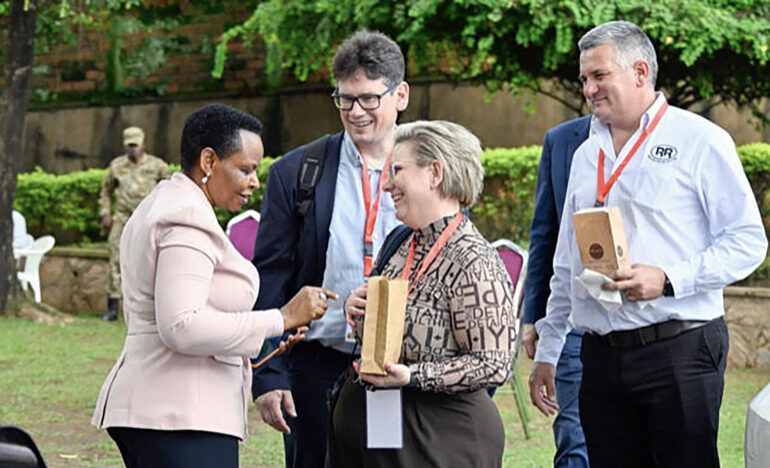
A high-level Danish delegation led by Jacob Kahl, Team Leader for Green Economy, Trade and Climate at the Embassy of Denmark in Uganda, engaged Ugandan authorities and investment agencies in a strategic dialogue aimed at unlocking opportunities in climate-smart agriculture, renewable energy, and vocational skilling, reports Pedson Mumbere.
The delegation brought together investors from leading global firms, including the Danish Agriculture and Food Council, signaling growing European interest in Uganda’s agri-business value chains and green growth agenda.
The meeting, held at the State House Investors Protection Unit (SHIPU), focused on modernising Uganda’s agricultural systems through technology transfer, improved post-harvest handling, and scalable value addition initiatives.
Uganda’s agriculture sector remains a cornerstone of the economy, contributing approximately 24% to GDP and employing over 70% of the population.
However, inefficiencies in post-harvest handling continue to cost the country an estimated 30–40% of output annually, translating into losses worth over UGX2.5 trillion (€600 million) each year.
Edith Nakalema said Uganda is keen to leverage Denmark’s global leadership in agricultural technology to address these structural challenges.
“Denmark is a global leader in agricultural technology, and we welcome your expertise in post-harvest handling, energy-efficient processing, and value addition,” she said.
She noted that Uganda is prioritising agricultural transformation through policy reforms, infrastructure investments, and institutional coordination aimed at attracting long-term capital into the sector.
Recent government interventions include the rollout of digital platforms such as the Electronic Investors Protection Portal (EIPP), designed to streamline investor engagement, enhance transparency, and improve inter-agency coordination.
The platform is expected to significantly reduce bureaucratic delays and strengthen investor confidence.
“We remain grateful for the strong confidence in Uganda’s investment climate, further boosted by our seamless Electronic Investors Protection Portal that fosters partnerships and inclusive economic growth,” Nakalema added.
She emphasised that investment facilitation is now being coordinated across key government institutions, ensuring efficiency, security, and faster implementation of projects.
“Our commitment is collaboration, coordination, and the protection of all investments in the country,” she said.
The engagement brought together senior officials from critical government agencies, including the National Planning Authority, Ministry of Finance Planning and Economic Development, Ministry of Agriculture Animal Industry and Fisheries, Uganda Revenue Authority, and the Uganda Tourism Board, among others.
Officials highlighted priority investment areas including expansion of wind energy, strengthening agro-processing capacity, and improving domestic production of quality fish feeds – an industry currently valued at over UGX500 billion (€120 million) annually but still heavily reliant on imports.
Kahl noted that Danish companies are increasingly looking to Uganda and the wider African market for sustainable investment opportunities, particularly in sectors aligned with green transition and food security.
In the tourism segment, Juliana Kagwa underscored Uganda’s positioning as both an investment destination and a tourism hub.
“Uganda is not just a destination – it’s an experience. With a young, vibrant population and a growing economy, the country presents immense potential for investment across sectors,” she said.
She added that continued engagement from Danish investors reflects growing international confidence in Uganda’s economic trajectory and reform agenda.
With agriculture identified as a key driver of Uganda’s ambition to expand its economy towards the $500 billion mark, partnerships with advanced economies such as Denmark are expected to play a pivotal role in accelerating productivity, enhancing value chains, and unlocking export competitiveness.