




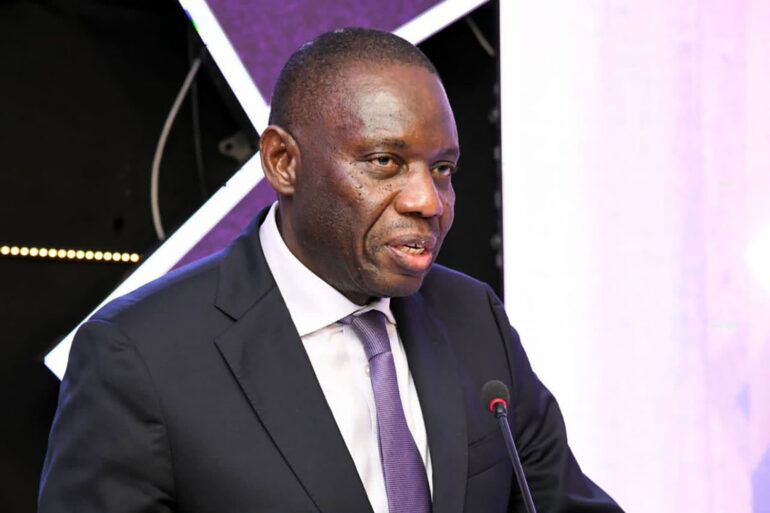
The Bank of Uganda (BoU) Governor, Michael Atingi-Ego, has called on the government to manage borrowing prudently to avoid crowding out private sector credit and ensure sustainable economic growth.
His remarks come amid plans to reduce Uganda’s fiscal deficit and shift focus toward domestic revenue mobilisation.
Speaking during a recent policy briefing, Atingi-Ego said that careful borrowing is essential to free up credit for businesses, particularly at a time when private enterprises are facing high interest rates of 19–21 percent.
“Banks often prefer lending to government projects because they are safer and yield higher returns. This leaves less capital available for private sector expansion,” he explained, emphasizing the need to balance public borrowing with private sector credit needs.
The governor highlighted that domestic borrowing is projected to decline from UGX 11.4 trillion this year to UGX 9 trillion in the 2026/27 financial year, while external budget support is expected to fall sharply by 84 percent, from UGX 2.1 trillion to UGX 331 billion.
Funding for externally financed projects will also drop slightly, from UGX 11.3 trillion to UGX 10 trillion.
“These measures are not a response to a financial crisis. They are deliberate steps to reduce borrowing, lower the fiscal deficit, and support economic stability,” Atingi-Ego noted. “Lower deficits mean less borrowing is required, which frees up credit for businesses and strengthens Uganda’s fiscal position.”
The government’s proposed budget for the 2026/27 financial year stands at UGX 69 trillion, down from UGX 72 trillion this year.
The reduction aligns with broader fiscal consolidation and debt management strategies, aimed at improving Uganda’s creditworthiness and limiting arrears.
Permanent Secretary to the Treasury, Dr. Ramathan Ggoobi, said the budget adjustments respond to declining external financing.
“With fewer funds coming from abroad, we are focusing on increasing domestic revenue while reducing reliance on borrowing,” he said.
The Ministry of Finance aims to collect UGX 40 trillion in domestic revenue next year, up from UGX36.8 trillion this year, through measures including the elimination of low-value tax incentives and utilisation of anticipated oil revenues from production expected to commence around July.
Analysts have cautioned that reduced government spending may affect critical sectors such as agriculture, education, and infrastructure development.
However, Atingi-Ego emphasized that the strategy is designed to prioritise sustainable medium-term fiscal management rather than short-term savings.
By carefully balancing expenditure and revenue collection, the government intends to create a stable economic environment conducive to private sector-led growth.
In addition to borrowing and fiscal policies, the BoU chief called on the Judiciary to expedite business-related cases.
He highlighted that approximately UGX 6 trillion is currently tied up in commercial courts, constraining capital circulation. “Resolving these cases promptly can unlock capital, boost investment, and accelerate private sector growth,” he said.
The budget adjustments and borrowing strategy are being implemented as Uganda advances its Fourth National Development Plan (NDP IV) and the Tenfold Growth Strategy, which seeks to expand the economy tenfold to USD 500 billion by 2040.
Reduced borrowing, improved revenue mobilisation, and prioritisation of key expenditures are expected to increase the availability of credit for businesses, lower interest rates, and incentivize investment in productive sectors.
Economists say that freeing up credit for the private sector is critical for sustaining high growth rates, expanding employment, and improving household incomes.
By addressing fiscal sustainability, debt management, and judicial efficiency simultaneously, Uganda aims to strengthen the foundation for private sector-led economic transformation over the next decade.