



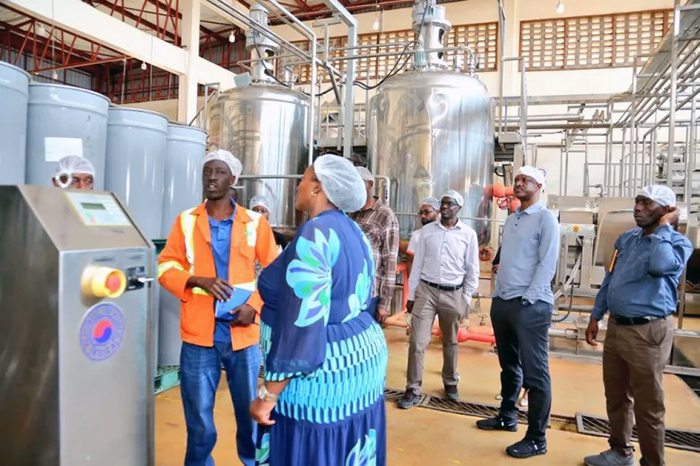
Uganda’s push toward agro-industrialisation has gained fresh momentum with the government announcing a UGX 115 billion expansion and modernisation plan for Soroti Fruit Factory.
The revelation was made by the Permanent Secretary and Secretary to the Treasury (PSST), Ramathan Ggoobi, during an assessment tour of the factory in Soroti City recently.
He was accompanied by senior officials including Trade ministry Permanent Secretary Lynette Bagonza and Finance ministry Director for Economic Affairs Moses Kaggwa.
This announcement comes at a time when agro-industrialisation is firmly recognised as a key driver of Uganda’s economic transformation.
Increasing value addition, particularly through fruit processing, is seen as essential for raising household incomes and improving the country’s export performance.
The government’s planned investment will introduce modern technology to improve efficiency and expand the factory’s capacity.
Construction is expected to take two years once work officially begins. The modernisation project will bring in equipment such as an automatic bottling and packaging line, allowing the plant to handle far larger production volumes.
It will also include multi-fruit processing units that will enable the factory to process a wider range of produce including citrus, mangoes, pineapples, and other fruits from across the Teso Sub-region.
In addition, the upgrade will support the development of facilities for producing organic fertiliser and animal feed from fruit waste.
By utilising by-products more efficiently, the factory is expected to significantly reduce wastage while boosting profitability.
Mr Ggoobi emphasised the transformative impact the factory is already having on the Teso Sub-region. More than 5,000 farmers currently supply fruit to the plant, providing them with a secure and reliable market.
This demand has encouraged farmers in Soroti, Serere, Ngora, Kumi, and surrounding districts to increase citrus cultivation. Over the last decade, citrus production in the region has grown by more than 40%, largely driven by the guaranteed market offered by the factory.
“The factory is changing the destiny of the region in terms of processing and adding value,” Mr Ggoobi said. He also applauded the Ethiopian management team for enhancing efficiency, stabilising production, and improving product quality.
Tsega Mariam Tesfaye, the Chief Commercial Officer of Soroti Fruits Ltd, thanked President Museveni and the Government of Uganda for their support, noting that the partnership was helping to industrialise and transform the region’s agricultural potential.
The expansion of Soroti Fruit Factory also speaks to Uganda’s broader agro-industrialisation agenda. The country aims to increase the proportion of processed agricultural exports from the current estimate of under 20% to more than 40% by 2040.
Agro-processed goods now constitute over 65% of Uganda’s merchandise exports, highlighting the expanding role of value addition in economic growth.
With the new investment expected to expand market access, increase production, and minimise post-harvest losses, Soroti Fruit Factory is poised to become a major agro-industrial hub.