



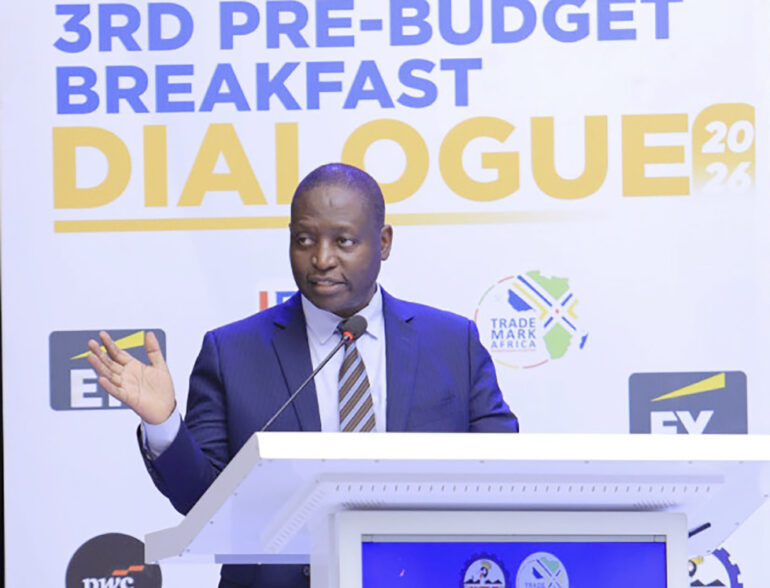
When David Bahati, the State Minister for Industry, went to be the chief guest at the 3rd Pre-Budget Breakfast Dialogue 2026, he probably didn’t know that the deliberations would be an eye opener to the concerns of the private sector about the country’s poor revenue mobilization efforts. Pedson Mumbere reports.
In his opening remarks, Bahati had emphasized the importance of continuous engagement between manufacturers, policymakers, and tax experts to address operational and fiscal challenges, improve the business environment, and ensure that industry perspectives shape national policy decisions.
“The success of our manufacturing sector depends on continuous dialogue between government and industry players,” Bahati said, highlighting that such partnerships are essential for driving innovation, competitiveness, and sustainable economic growth.
The dialogue, which focused on the fourth National Development Plan (NDP IV), brought together key stakeholders in the manufacturing ecosystem to discuss strategies for improving production efficiency, regulatory compliance, and fiscal planning ahead of the 2026 national budget.
A major highlight of the discussions, however, was the growing concern over illegal and informal trade, which industry leaders warn is undermining Uganda’s industrial growth.
The Uganda Manufacturers Association (UMA) has formally petitioned the government to implement stricter measures to curb the trade, noting that it is shrinking the tax base and threatening legitimate factories.
UMA Chairman Aga Sekalala Jr. said rising informality in the market is a direct threat to Uganda’s economic targets, including the ambition to achieve a $500 billion economy in 15 years.
“While manufacturing employs 2.5 million people and contributes 30 percent of domestic revenue, the sector needs better enforcement of quality standards to survive,” he said.
Sekalala cited a recent Uganda Revenue Authority report revealing alarming levels of illicit goods on the local market: 67 percent of alcohol, 40 percent of cement, and 30 percent of pharmaceuticals are unregulated or counterfeit.
He added that informal operators and counterfeiters dealing in steel, beverages, toiletries, and oils are causing the economy to lose more than Shs 2.5 trillion annually, while often evading taxes and ignoring safety regulations.
Patricia Ejalu, Deputy Executive Director at the Uganda National Bureau of Standards (UNBS), urged the government to adopt stronger enforcement strategies, pointing to Kenya’s Anti-Counterfeit Authority as a model.
“Kenya uses digital tracking and multi-agency operations to seize illegal goods. Uganda cannot afford to lag behind,” she said. Ejalu emphasized that local agencies require more staff, funding, and mobile testing laboratories to be effective in enforcing standards.
Minister Bahati reassured manufacturers that their concerns would be presented to Cabinet, and encouraged local firms to explore export opportunities in the Democratic Republic of Congo, where Uganda currently exports nearly $900 million in goods.
However, he stressed that compliance with quality standards is non-negotiable. “The issue of standards is key, and we spend reasonable money trying to enforce them,” he said.
The discussion also touched on regional integration. TradeMark Africa Country Director Anna Nambooze highlighted the importance of the African Continental Free Trade Area (AfCFTA). She noted that reducing non-tariff barriers would allow Ugandan businesses to compete more effectively across the region, boosting both exports and industrial growth.
The dialogue concluded with a consensus on the need for stronger collaboration between government and industry, enhanced enforcement of standards, and strategic use of regional trade opportunities.
Stakeholders agreed that tackling informal and illegal trade, while improving the regulatory environment, is essential for creating a competitive and resilient manufacturing sector that can support Uganda’s broader economic ambitions.
By combining public-private collaboration with strict enforcement and regional market expansion, Uganda’s manufacturing sector aims to position itself as a driver of economic growth, job creation, and sustainable industrial development.
The 2026 pre-budget dialogue has set the stage for actionable strategies that could strengthen compliance, attract investment, and enhance Uganda’s standing in the East African and continental industrial landscape.