



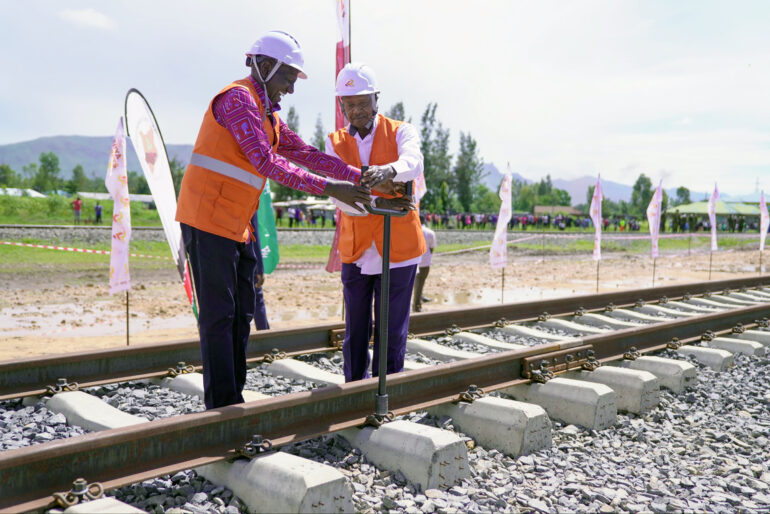
The launch of the Kisumu–Malaba Standard Gauge Railway (SGR) Extension (Phase II) marks a pivotal step in strengthening regional trade and economic integration across the East African Community (EAC), positioning the Northern Corridor as a more efficient and competitive trade route.
Presided over by Yoweri Kaguta Museveni and his Kenyan counterpart William Ruto in Kisumu, the project underscores a renewed commitment by regional leaders to invest in transformative infrastructure that unlocks trade potential and drives industrial growth.
The SGR extension is a strategic infrastructure investment designed to enhance connectivity between Kenya’s hinterland and Uganda’s border at Malaba, providing a seamless link to the Port of Mombasa East Africa’s primary maritime gateway.
By improving rail connectivity, the project is expected to significantly reduce cargo transit time and logistics costs along the Northern Corridor, which handles the bulk of trade for landlocked countries in the region.
According to regional trade data, the EAC bloc comprising Uganda, Kenya, Tanzania, Rwanda, Burundi, South Sudan and the Democratic Republic of the Congo records intra-regional trade estimated at over $13 billion (approximately UGX 49 trillion) annually.
However, this represents less than 20 percent of the region’s total trade potential, largely due to infrastructure bottlenecks and high transport costs.
The Northern Corridor, anchored by the Port of Mombasa, handles more than 30 million metric tonnes of cargo annually, with over 80 percent of transit goods destined for Uganda and its neighboring markets.
Uganda alone accounts for about 25–30 percent of the port’s total throughput, highlighting its strategic role as a key transit hub for regional trade.
With the SGR extension, cargo movement from Mombasa to the hinterland is projected to become faster and more cost-efficient.
Current estimates indicate that rail transport could reduce the cost of moving a 20-foot container from Mombasa to Kampala by up to 30 percent, while cutting transit time from several days by road to less than 24 hours by rail once the full network is operational.
President Museveni emphasized the importance of integrated infrastructure planning in reducing the cost of doing business across the region.
He noted that prioritizing rail for bulk cargo, pipelines for petroleum products, and roads for passengers and light goods would optimize efficiency and address key economic constraints such as high logistics and energy costs.
“This project is not just about transport; it is about lowering the cost structure of our economies and enhancing our competitiveness in global markets,” he said.
President Ruto echoed similar sentiments, highlighting the role of modern rail infrastructure in unlocking regional value chains, particularly in agriculture, manufacturing, and extractives.
He noted that improved logistics would facilitate the movement of goods such as coffee, tea, fish, and minerals, enabling producers to access regional and international markets more competitively.
The SGR extension is also expected to stimulate trade flows to and from eastern Democratic Republic of the Congo, a market of over 90 million people, which has increasingly become a key destination for Ugandan exports.
Uganda’s exports to the DRC alone are estimated at over $500 million (approximately UGX 1.9 trillion) annually, with significant growth potential as infrastructure improves.
Additionally, the project is poised to benefit regional fisheries and agricultural sectors, particularly around Lake Victoria, by improving cold chain logistics and reducing post-harvest losses.
Faster and more reliable transport systems would enable producers to move perishable goods to markets more efficiently, boosting incomes and export earnings.
From a macroeconomic perspective, the SGR extension aligns with the EAC’s broader agenda of deepening regional integration and increasing intra-African trade under the African Continental Free Trade Area (AfCFTA).
By addressing critical infrastructure gaps, the project is expected to enhance supply chain efficiency, attract investment, and support industrialisation across the Great Lakes region.
Analysts note that improved rail connectivity will also ease congestion on regional highways, reduce road maintenance costs, and lower carbon emissions, contributing to more sustainable economic growth.
As construction progresses, stakeholders remain optimistic that the SGR extension will serve as a catalyst for transforming East Africa into a more connected, competitive, and resilient economic bloc.
By unlocking trade corridors and reducing logistical inefficiencies, the project is set to play a central role in accelerating economic growth, boosting exports, and strengthening regional value chains.