




For millions of Ugandans, the idea of insurance has never quite felt like it belonged to them. For some, the hesitation is financial.
For others — particularly Muslim communities — the reservations run deeper, rooted in faith.
Conventional insurance, as it is widely practised, involves elements that Islamic law prohibits: interest (riba), excessive uncertainty (gharar), and speculative risk (maysir).
For devout Muslims, engaging with such products is not merely uncomfortable; it is forbidden. That, until now, has left a significant gap.
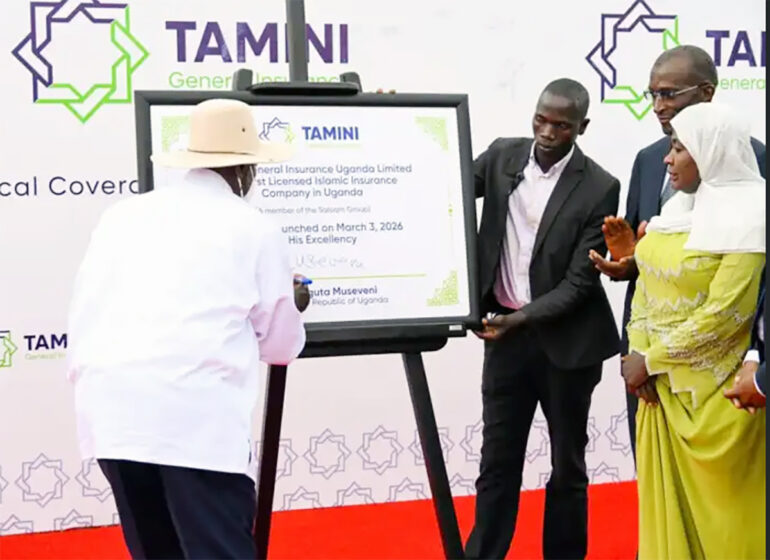
That gap narrowed meaningfully this week when President Yoweri Museveni launched Tamini General Insurance, Uganda’s first fully-fledged Islamic insurer, at an Iftar dinner in Kampala.
A subsidiary of Salaam Group, Tamini operates on the Takaful model: a centuries-old system of cooperative, faith-compliant risk protection that is today reshaping financial markets from Kuala Lumpur to London.
The word Takaful comes from the Arabic kafalah — meaning “guaranteeing each other.” Rather than transferring risk to a profit-driven insurer, participants pool their contributions into a shared fund.
When a member suffers a loss, they are compensated from that collective pool. Any surplus left after settling claims and covering expenses is invested only in Sharia-compliant ventures, and profits are returned to participants.
This is not a niche arrangement. The global Takaful industry had grown to $27.7 billion in contributions by 2018 and continues to expand at roughly two to four times the rate of conventional insurance.
Critically, Takaful is not exclusive to Muslims: providers in the United Kingdom, Singapore, and South Africa have demonstrated that the model appeals broadly to anyone seeking ethical, transparent financial products.
Uganda’s insurance penetration remains below 1% of GDP — a stark contrast to Kenya’s 2.3% and a marker of the vast opportunity that lies ahead. Yet the foundation is improving.
The Insurance Regulatory Authority reports that gross written premiums surged from Shs240 billion in 2020 to Shs2 trillion in 2025 — an eightfold leap in just five years. The question now is who gets included in the next wave of growth.
President Museveni framed the launch in terms of Uganda’s broader economic transformation.
He noted that in 2013, only 32% of Ugandans were actively participating in the formal money economy. Government initiatives have pushed that figure to approximately 70% today. The remaining 30%, he said, represent the next frontier — and Tamini is squarely aimed at reaching them.
Tamini’s arrival is not an isolated event. It builds on Uganda’s legalisation of Islamic banking and finance in 2023 and slots into a value chain that stakeholders say was previously incomplete.
Mohamed Bahdon, the firm’s Chief Executive, described the synergy plainly: a farmer who accesses Halal financing from Salaam Bank to grow coffee or expand a livestock business can now protect that same investment through Tamini — without compromising their faith at any step.
Authorities are also preparing to introduce Sukuk — Islamic bonds — to expand Uganda’s long-term infrastructure financing options.
Together, Islamic banking, Takaful insurance, and Sukuk capital markets represent a self-contained, Sharia-compliant financial architecture: one that mobilises domestic savings, attracts ethically conscious investors, and strengthens economic resilience.
Perhaps the most significant aspect of this development is what it signals about financial inclusion as a concept. Tamini is not asking Ugandans to set aside their values to access economic protection. It is building the system around those values.
Ibrahim M. Abdirahman, Chairman of Salaam Bank Uganda, summarised it well: for a significant segment of Uganda’s population, the barrier to insurance has never been poverty alone — it has been principle. Takaful removes that barrier.
For Uganda — a country of almost million people projected to reach 100 million by 2050, with a youthful population and an agricultural economy highly exposed to climate risk — expanding the insurance base is not just good business. It is essential infrastructure.
Whether or not one understands the finer points of Islamic finance, the underlying idea is intuitive: protect your neighbour, and your neighbour will protect you.