



Kenya has unveiled ambitious plans to deepen regional cooperation, trade, and economic integration as it prepares to co-host the Africa–France Forward Summit in May next year.
The summit, expected to attract leaders, policymakers, and innovators from across Africa and Europe, aims to strengthen Africa–Europe partnerships and drive key continental development priorities.
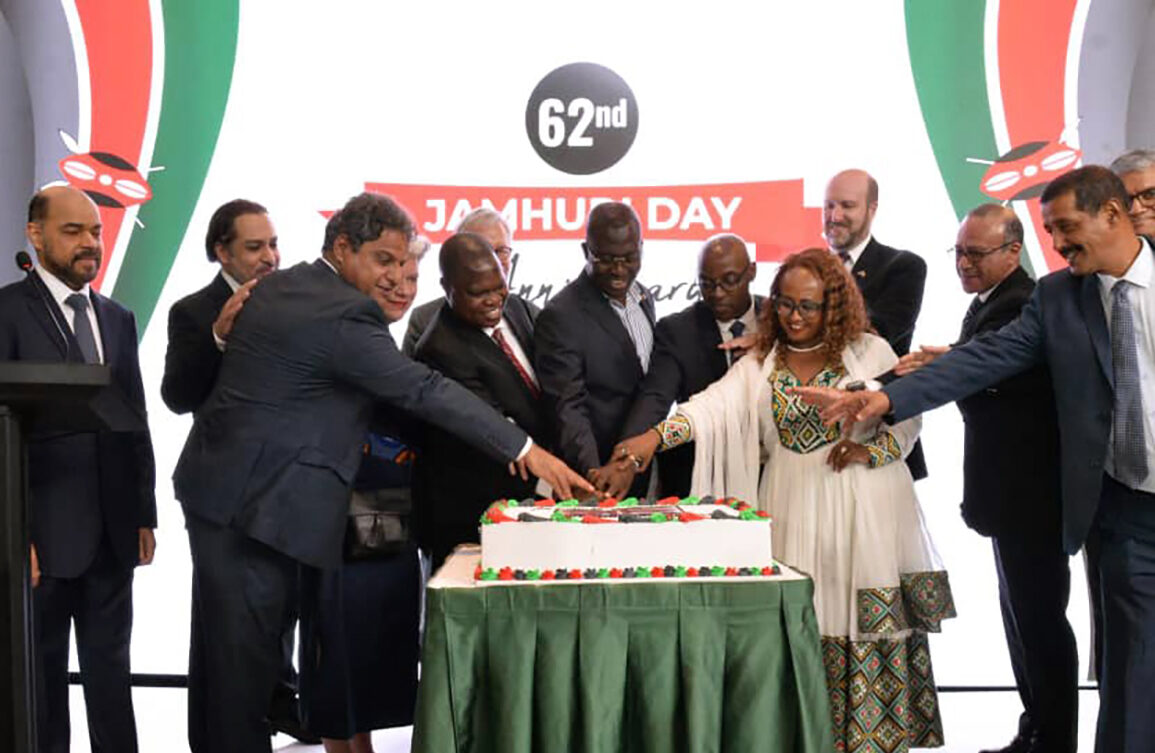
Speaking at the Kampala Sheraton Hotel during Kenya’s Jamhuri Day celebrations, Kenya’s Ambassador to Uganda, Joash Maangi, said the summit will be held in Nairobi and co-hosted by President William Ruto and President Emmanuel Macron. Ambassador Maangi emphasized Kenya’s eagerness for Uganda to play a meaningful role in shaping the outcomes of the high-level engagement.
“We warmly invite Uganda to walk with us as a close partner and brother in shaping the outcomes of this important continental engagement. This summit will focus on economic transformation, sustainable development, innovation, and strategic Africa–Europe partnerships, with Nairobi positioning itself as a leading diplomatic hub for global engagement with the continent,” Ambassador Maangi said.
Uganda’s Minister of State for Foreign Affairs in charge of Regional Affairs, John Mulimba, who officiated the celebrations, hailed Kenya’s independence as both a national milestone and a reflection of the enduring ties between the two countries.
“Over the decades, Uganda and Kenya have built a strong, resilient, and evolving partnership, grounded in East African Community cooperation and sustained through political dialogue, mutual trust, and shared priorities,” Mulimba said.
Praising Kenya’s economic policies, Mulimba said annual trade between Uganda and Kenya now exceeds $1.3 billion (Sh4.615 trillion), a figure he said has significantly contributed to both nations’ socio-economic transformation.
He expressed confidence that Kenya’s regional agenda will continue to complement Uganda’s development priorities under the Fourth National Development Plan, aimed at accelerating economic growth and deepening integration across East Africa.
More collaboration
He noted that collaboration has flourished across trade, education, research, security, transport, and development cooperation, emphasizing the importance of cross-border partnerships in fostering regional stability and economic growth.
Mulimba highlighted Kenya’s strategic role in Uganda’s history, recalling times when Kenya generously hosted Ugandan refugee families and supported the country’s economic recovery after 1986, facilitating access to international markets and trade in key agricultural and industrial products.
Beyond diplomacy, Ambassador Maangi stressed the importance of joint tourism promotion between Kenya and Uganda. Coordinated marketing efforts, he argued, could elevate East Africa as a single, compelling destination for international travelers.

“Kenya strongly believes that joint tourism marketing with Uganda will yield even greater dividends, as the Pearl of Africa meets the Pride of Africa. Together, we can attract global tourists, expand business travel, and showcase the unique cultural and natural assets of our region,” he said.
The ambassador also highlighted the expansion of regional air connectivity as a transformative factor for trade, tourism, and investment. Recent improvements in air routes linking Entebbe, Western Kenya, and Nairobi are increasing the mobility of goods, people, and services, fostering cross-border business growth.
“These new air links are opening up fresh opportunities for trade, investment, and people-to-people exchange across the region,” he said.

He reaffirmed Kenya’s commitment to peace and security in the Great Lakes region, noting that political stability is essential for sustainable tourism and social-economic development.
“We support all efforts aimed at restoring lasting peace in the Democratic Republic of Congo and the wider Great Lakes region. Peace is the foundation of development, and if we commit to it, we commit to development,” he said.
Ambassador Maangi further highlighted Kenya’s infrastructure expansion programme, aimed at enhancing regional connectivity and trade efficiency.
He said the Kenyan government is focusing on improvement of the Northern Corridor, the main transport artery connecting the Port of Mombasa to Uganda, Rwanda, South Sudan, and beyond.
“Our flagship project is the Rironi–Malaba road, which stretches from Nairobi’s outskirts to the Kenya–Uganda border. Beyond increasing road capacity, the project includes modern safety features, improved drainage, service lanes, pedestrian walkways, and redesigned interchanges, all designed to ease the movement of goods and people,” he said.
Additionally, he said Kenya has secured funding to extend the Standard Gauge Railway (SGR) from Naivasha to Malaba, providing a faster, safer, and higher-capacity alternative to road transport.
The railway extension is expected to reduce transport costs, ease congestion, improve road safety, and enhance trade efficiency across the region.
“Together, the modernisation of the Northern Corridor, the upgrading of One-Stop Border Posts, and the planned railway extension form a comprehensive strategy to enhance regional connectivity and trade efficiency. These investments reflect Kenya’s belief that the Port of Mombasa is a regional port, serving not just Kenya, but all countries in the hinterland, including Uganda,” Ambassador Maangi said.
He further noted that joint efforts through the African Union, EAC, COMESA, and IGAD have strengthened peace, security, refugee management, and cross-border trade, reinforcing regional resilience and socio-economic development.