



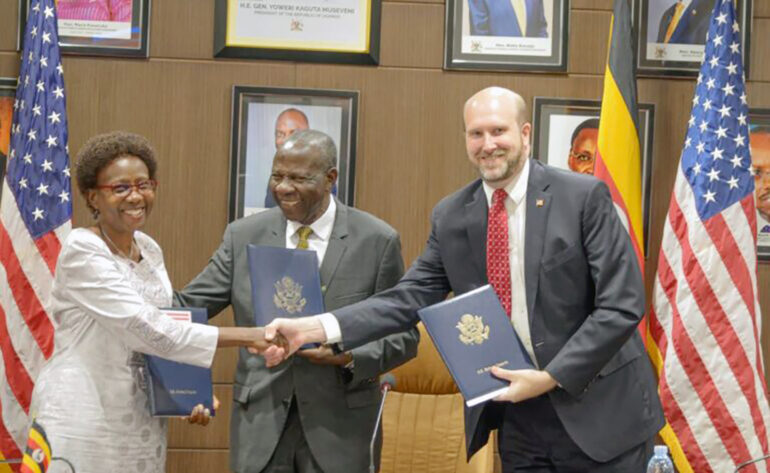
The United States and Uganda have signed a landmark five-year $2.3 billion (about Sh8.16 trillion) health cooperation Memorandum of Understanding (MOoU) whose aim is to transform Uganda’s health system, expand service delivery, and strengthen global health security.
The agreement, one of the most ambitious bilateral health packages Uganda has secured, aims to boost disease prevention, reinforce national institutions, and ensure long-term sustainability of health programmes.
At the signing ceremony today in Kampala, U.S. Ambassador to Uganda William W. Popp said the agreement represents a major milestone in the countries’ long-standing health partnership.
He said, “This agreement represents a significant commitment by the United Stwates and Uganda to co-invest in our shared global health priorities.
Today, we are building on decades of progress and moving deliberately toward promoting self-reliance through strong community health systems, clear performance metrics, and a firm investment in data systems and global health security.”
Ambassador Popp emphasised that the improved partnership will help prevent and stop outbreaks from threatening Uganda, the United States and the world.
Under the MoU, the US plans to invest up to $1.7 billion (about Sh6.04 trillion) between 2026 and 2030, while the Government of Uganda has pledged to increase domestic health spending by more than $500 million (about Sh1.78 trillion) as it gradually assumes greater financial responsibility.
The partnership also includes substantial support to faith-based healthcare providers, who serve millions across Uganda.
Finance Minister Matia Kasaija applauded the collaboration, and reiterated Uganda’s commitment to meet its financial obligations under the MoU.
“We commit to increasing our own budgetary contribution to the health sector by more than $500 million. This collaboration will improve national systems, institutions, and workforce capacity, which is highly commendable,” he said.
Health Minister Dr. Jane Ruth Aceng explained that the framework provides two vital streams of support that will shape Uganda’s health sector over the next decade.
The first is predictable and flexible budget support, enabling the government to recruit and retain health workers, upgrade infrastructure, and plan strategically for long-term needs.
The second is off-budget support, which ensures access to essential medicines, technical expertise, commodities, and support from implementing partners, aligned with the priorities of the Ministry of Health.
The MOU contains several innovative provisions intended to strengthen long-term sustainability. One key component is the gradual transition of health commodity procurement from the U.S. Government to the Government of Uganda.
Over the next five years, Uganda will assume responsibility for purchasing most essential medical commodities, significantly boosting the country’s supply chain systems and institutional capacity.
Another major provision is the integration of frontline health workers currently funded by U.S. programmes into government structures.
These workers will be mapped to relevant health cadres and progressively placed on the Government of Uganda payroll to ensure continued service delivery without disruption.
The agreement also prioritises investment in Uganda’s data and disease surveillance systems.
The United States will channel significant resources into improving electronic medical records, data capture, and interoperability between health information systems. These investments will advance Uganda’s digitisation agenda and strengthen early warning systems for future outbreaks.
Support for faith-based healthcare providers is also embedded in the MOU. Uganda plans to expand assistance to these institutions through increased primary health care grants, performance-based service agreements, digitisation efforts, and community health insurance initiatives to ensure equitable access to quality health services.