




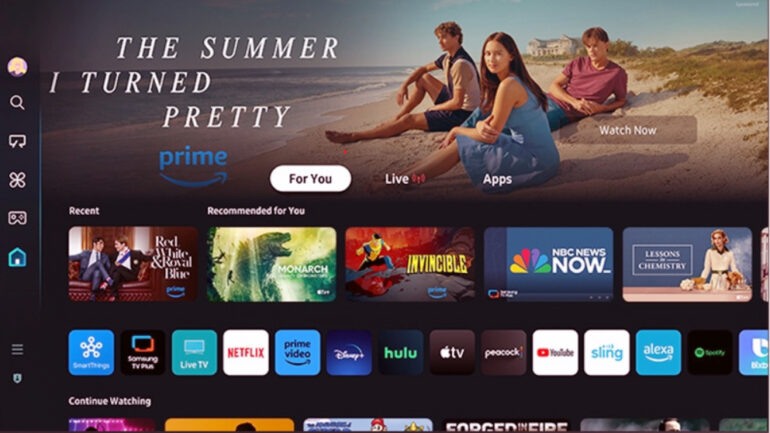
On June 1, 2026, a quiet but consequential shift took hold across 18 African countries. Samsung Smart TVs began rolling out with the DStv Stream app pre-installed. No dish. No decoder. No technician at the door. Just a screen, wifi, and a login.
For Canal+, the French broadcasting giant that acquired MultiChoice last year in a R54 billion deal, this is more than a distribution arrangement. It is a declaration about the future of television in Africa.
The partnership marks the first time DStv Stream has been pre-installed on Samsung Smart TVs across English and Portuguese-speaking African markets.
It extends an existing Canal+ and Samsung collaboration already active across 40 markets in Europe and Asia.
In Africa, MultiChoice has spent several years watching its premium satellite subscriber numbers fall. Canal+ inherited a business under pressure, and it is moving fast to make it work.
The satellite dish and decoder, once the unmistakable centrepiece of the African middle class homes, are quietly losing their place as status symbols. A dish demands installation, maintenance, and physical access.
An app demands none of these. It updates itself, integrates new content partners, and sits directly on the home screen.
When Canal+ announced earlier this year that it was exploring embedding HBO Max and Apple TV within its own app, the logic became clear. One interface and everything inside.
This evolution did not happen overnight. Samsung launched its first true Smart TV in 2008.
A few years later, Netflix and YouTube had transformed television from a passive broadcast receiver into a demand-driven multimedia platform.
The Smart TV severed the old dependency on cable companies and satellite providers. Content began flowing directly from creator to viewer.
For Africa’s growing urban middle class, this shift has real meaning. In cities like Nairobi, Lagos, and Kampala, a new generation of consumers owns Smart TVs and expects on-demand access to sports, drama, and the latest movies.
The pre-installed DStv Stream app removes the final barrier. New TV buyers no longer need to seek out the app from app stores. It comes already pre-installed – simply plug and play.
Yet the picture is not uniformly bright. Streaming runs on internet bandwidth, and bandwidth remains uneven across the continent. In Uganda, for instance, urban households in Kampala have embraced Smart TVs alongside satellite – call them ‘hybrid’ users.
They keep their DStv satellite connection for Premier League games because reliability matters most. They use streaming for everything else.
The mass-market subscriber, however, often lives beyond stable broadband. GOtv’s significantly large base, which relies on pocket-friendly decoder packages, is not yet ready to cut the cord.
Satellite remains the backbone where internet infrastructure is inconsistent and data costs are high.
MultiChoice and Canal+ understand this tension. Their strategy is not to abandon satellite completely. It is to grow the streaming tier aggressively among the consumers who are ready.
The Samsung partnership is the clearest signal yet of where that growth is expected to come from.
Undoubtedly, the television industry in Africa is moving from the rooftop to the cloud. Canal+ is betting that millions of new Smart TV buyers across the continent will follow.