



Uganda has spent two decades preparing for this moment. From the first commercial oil discovery in 2006 – guided by the Energy Policy of 2002 – through the National Oil and Gas Policy of 2008, and now to the freshly launched National Petroleum Policy 2025, the country has built a layered policy architecture to govern one of sub-Saharan Africa’s most consequential resource stories.
Pedson Mumbere reports that Deputy Speaker Thomas Tayebwa formally unveiled the new policy at the 11th Annual Oil and Gas Convention at Speke Resort Munyonyo, with an audience of international oil companies, financiers, and private sector leaders in attendance.
The timing could not be more charged.
Globally, oil markets are under severe stress – the conflict involving Iran, the United States and Israel has effectively shut the Strait of Hormuz, the chokepoint through which 20% of the world’s crude supply passes.
Fuel prices in Uganda are already climbing, and officials were pressed at the convention to explain government’s response.
It was an uncomfortable but fitting backdrop for a policy that is fundamentally about Uganda taking greater control of its own energy destiny.
The numbers embedded in this policy are striking. Uganda sits on an estimated 6.5 billion barrels of oil reserves, with 1.4 billion barrels recoverable.
Gas resources stand at 500 billion standard cubic feet, and 60% of the Albertine Graben remains unexplored – meaning the full resource picture is still unfolding.
At peak production, the Tilenga and Kingfisher fields, operated by TotalEnergies, CNOOC and the Uganda National Oil Company, are expected to produce 230,000 barrels per day.
Over the lifetime of current resources, the State Cumulative Cash Flow is projected at approximately UGX122 trillion – a figure that dwarfs Uganda’s current annual budget.
The 1,443-kilometre East African Crude Oil Pipeline (EACOP), running from Hoima to Tanzania’s Tanga Port, is the centrepiece of the export architecture.
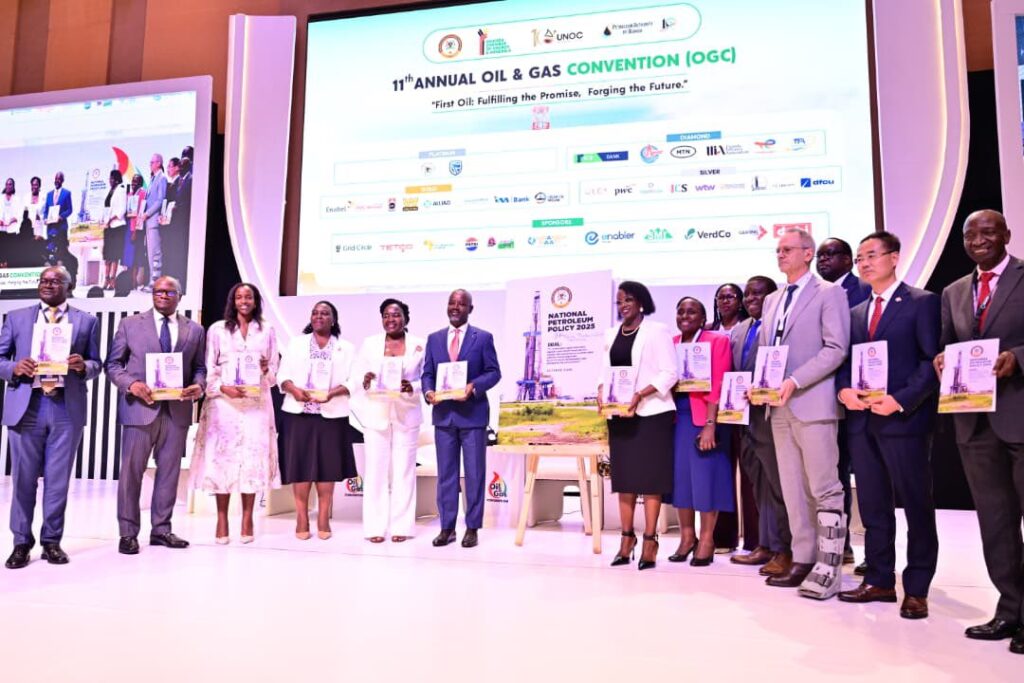
Officials show off copies of the Petroleum Policy at the launch
Total sector investments already exceed USD 20 billion – making this one of the largest energy investment programmes in East Africa.
Yet, the most instructive framing in the policy is not about oil wells. It is about economic transformation.
Uganda currently imports 95% of its petroleum products through Kenya and 5% through Tanzania, at a cost exceeding USD 2 billion annually – more than 10% of the country’s total import bill.
Domestic consumption stands at 2.5 billion litres per year, growing at 7% annually.
A country that both produces oil and imports virtually all its refined products is a country leaving enormous value on the table.
The new policy directly targets this gap by mandating value addition and in-country processing as policy goals, not aspirations.
The broader economic bet is equally ambitious. Uganda’s Tenfold Growth Strategy targets an expansion from roughly USD 50 billion today to USD 500 billion by 2040.
Tayebwa was direct about the petroleum sector’s role in that journey: “The petroleum sector presents Uganda with a once-in-a-generation opportunity to accelerate economic transformation, deepen industrial capacity, create jobs, and strengthen local enterprise participation.”
Ugandan firms have secured contracts worth over USD 2.3 billion in catering, transport, civil works, security, ICT and professional services.
Banking, insurance, manufacturing, logistics, construction and real estate are all experiencing spillover demand.
But Hon. Tayebwa was pointed in his challenge to both government and the oil companies: Ugandans must move beyond low-skilled contracts and into engineering, fabrication and specialised petroleum services.
The policy assigns clear institutional mandates. The Petroleum Authority of Uganda regulates the entire value chain.
The Uganda National Oil Company manages the State’s commercial interests and participating stakes – though the policy acknowledges that UNOC needs further capacity strengthening to fully discharge this role independently.
Crucially, the policy will be reviewed in ten years, with five-year mid-term appraisals built in – a governance feature that signals intent to adapt rather than simply legislate.
The road ahead carries real risks. Petroleum revenues are finite by definition, environmental stakes in the Albertine region are high, and the so-called “resource curse” – where oil wealth distorts governance and crowds out productive diversification – is a documented pattern across Africa.
Analysts consistently flag that Uganda’s petroleum windfall will only translate into lasting prosperity if revenues are managed with transparency and deliberately reinvested into productive sectors.
For now, the policy provides the framework. First oil, expected as early as July, will provide the test.