




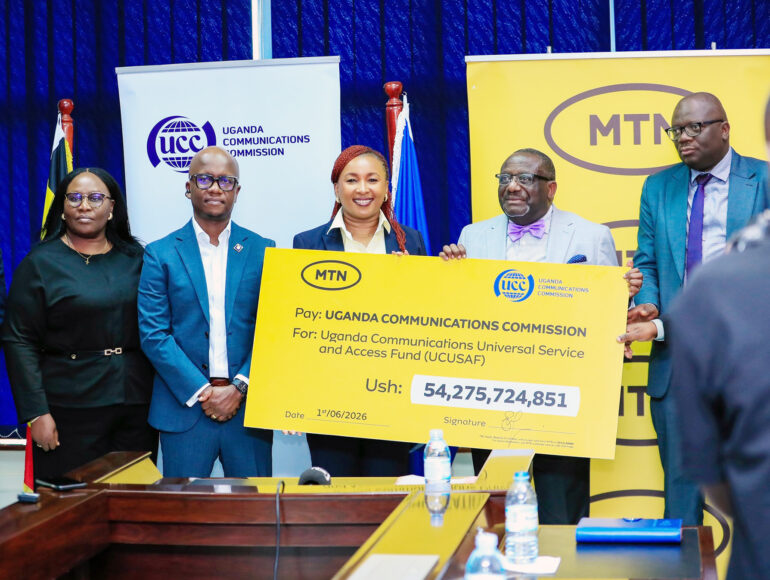
MTN Uganda has contributed UGX 54.27 billion to the Uganda Communications Commission’s Universal Service and Access Fund (UCUSAF), reinforcing its commitment to digital inclusion and Uganda’s digital transformation agenda.
Announced during a handover ceremony at the Uganda Communications Commission (UCC) headquarters in Kampala, the contribution reflects a rising trend in MTN Uganda’s annual statutory payments, from UGX 36 billion in 2023 to UGX 42.5 billion in 2024, UGX 50.55 billion in 2025 and UGX 54.27 billion in 2026 – indicating a 33.5% increase in four years.
Under Uganda’s regulatory framework, telecommunications operators are required to contribute 2% of annual gross revenue to UCUSAF, which is administered by the UCC.
Established in 2001 and formerly known as the Rural Communications Development Fund (RCDF), UCUSAF supports connectivity, affordability and equitable access to ICT services, particularly in rural and underserved communities.
Speaking at the event, MTN Uganda Chief Executive Officer Sylvia Mulinge said the contribution reflects more than regulatory compliance; noting that it also demonstrates a broader commitment to ensuring that all Ugandans can participate meaningfully in the digital economy.
“These contributions reflect our belief that every Ugandan, regardless of where they live or what they earn, deserves the benefits of a modern connected life because in today’s world, connection is opportunity,” Mulinge said.
Mulinge added that whereas Uganda has made strong progress in expanding access, significant gaps in digital inclusion remain.
UCC Executive Director George William Nyombi Thembo commended MTN Uganda for its consistent and timely contributions to the Universal Service and Access Fund.
“While this contribution is a regulatory obligation for MTN, it represents much more than compliance. It reflects MTN’s continued commitment to the growth of Uganda’s ICT sector. As UCC, we remain committed to working closely with MTN and other industry players to advance ICT development and achieve a fully connected Uganda by 2030,” Thembo said.
With more than 20 million smartphones connected in a country of over 45 million people, Mulinge said the task now is to close the access gap for millions of Ugandans still outside the digital economy, in line with the government’s broader priorities under the FY 2026/27 Budget, which include the expansion of digital infrastructure to increase coverage, reliability and affordability of internet, Government services and e-commerce.
Over the past three years, MTN Uganda has invested more than UGX 4 billion in the MTN ACE programme, with a further UGX 4 billion planned over the next three years.
Across these investments, MTN Uganda is combining physical access, digital training and innovation support to create measurable impact.
Mulinge said that as government prioritises digital transformation, the next phase must focus on widening access by making smartphones more affordable, particularly for low-income and underserved communities. Uganda currently applies a 10 per cent import duty and 18 per cent VAT on devices, which continue to limit access for many households, she said.
“Government has rightly prioritised digital transformation, and Uganda has made meaningful progress. The next frontier of inclusion is access. We need to unlock smartphone affordability, because that is the gateway through which millions of Ugandans connect to learning, enterprise, financial services and opportunity,” she said.
Last month, Airtel Uganda also handed over a cheque worth about UGX 43 billion to the UCC under the same framework.