
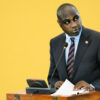




At Hotel Africana in Kampala on Monday, URA Commissioner General John Musinguzi stood during the National Post Budget Dialogue and made a pointed declaration:
Uganda’s tax-to-GDP ratio must climb from 14.2 percent to 16 percent this financial year.
For a country that has spent decades struggling to lift this single number, the announcement carried real weight.
Uganda moved from 13.7 percent to 14.2 percent last year.
Modest, one could say, but it was progress. Now the URA suggests that they have engaged another gear..
Musinguzi framed the medium-term ambition even higher, between 18 and 20 percent within two to three years.
That range, he said, is what can sustainably fund a national budget without constant borrowing.
The engine behind this new confidence is oil. Commercial production begins later this year, and officials expect it to do more than fill government coffers directly.
Finance Minister Henry Musasizi told the dialogue that growth is projected to exceed 10 percent in the 2026/27 financial year.
That would mark Uganda’s first double-digit growth since the reforms of the 1990s.
Oil revenue itself is projected at UGX 1.44 trillion this year.
The larger prize lies in its ripple effects: more wages, more VAT collections, more foreign investment flowing into related industries, among others.
Why does this ratio matter so much?
It measures how much of a nation’s economic output the government actually captures in the form of tax.
A low ratio means heavy reliance on borrowing and donor support.
A higher one means a country can fund its own roads, medical services and schools.
The International Monetary Fund treats 15 percent as a minimum threshold for functioning State capacity.
Uganda has only just crossed that line. Most of the Sub-Saharan Africa countries are still struggling to achieve it.
The reasons for Uganda’s historically low ratio are structural, not accidental.
A large share of economic activity remains informal, outside the reach of standard tax mechanisms.
Generous exemptions, often granted “to attract investors,” quietly erode the tax base. Government databases across ministries and agencies still do not talk to each other efficiently, making it hard to track who owes what.
These are not new problems, and they will not disappear because of oil wells pumping crude oil.
Musasizi was candid about the balancing act this requires, especially in regard to fiscal discipline.
He said tax should be a responsibility rather than something enforced through policing.
Citizens comply willingly, he argued, when they see their money return as better roads, healthcare and jobs.
He also promised tighter action on corruption and stronger accountability for how collected revenue is spent. That promise matters.
As URA Board Chairman Emmanuel Katongole put it, every shilling properly collected reduces the burden of borrowing.
Every shilling lost to leakage becomes debt someone else must repay some day.
The URA is not relying on oil alone. It is broadening the tax base by expanding withholding taxes on foreign debt interest, entertainers and digital software imports, areas that have long escaped scrutiny.
It is also integrating data across land registries, utility providers and procurement systems to find taxpayers hiding in plain sight.
However, none of this guarantees success. Climate shocks could hurt agricultural output.
High energy costs could slow manufacturing.
Ad-hoc tax holidays could quietly undo the gains. But the direction is set, and the tools are more sophisticated than before.
Whether Uganda emulates regional counterparts Kenya and Tanzania to scale the elusive 16 percent mark this year will say less about oil and more about discipline: administrative discipline, political discipline and the discipline to spend wisely what gets collected.