




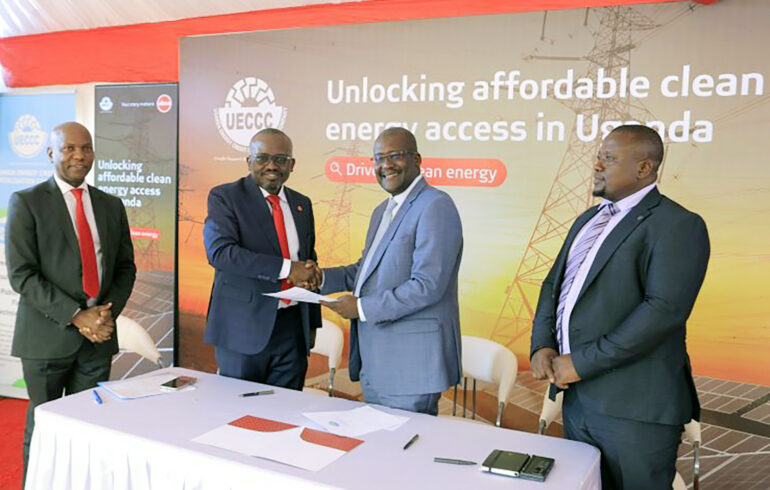
Absa Bank Uganda has entered into a strategic partnership with the Uganda Energy Credit Capitalisation Company (UECCC) to roll out a UGX 11.085 billion concessional financing facility aimed at accelerating renewable energy adoption and expanding access to affordable clean energy solutions across Uganda.
The financing agreement, implemented under the government’s Electricity Access Scale-Up Project (EASP), is expected to increase the availability of affordable credit to clean energy companies involved in solar home systems, institutional solar installations, productive-use equipment, and clean cooking technologies.
The transaction comes amid mounting pressure to close Uganda’s energy access gap, despite significant growth in electricity generation capacity.
According to the Electricity Regulatory Authority (ERA), Uganda’s installed generation capacity now exceeds 2,050 megawatts, up from less than 900MW a decade ago, driven largely by investments in hydropower projects such as Karuma and Isimba.
However, electricity access remains uneven. National electrification stands at approximately 60%, with urban access estimated at 76.4% compared to just 42.4% in rural areas.
More than 28 million Ugandans still lack reliable electricity access, limiting productivity, digital inclusion, and economic participation.
At the household level, reliance on traditional fuels remains dominant. Government estimates show that over 90% of households continue to depend on biomass fuels – including charcoal and firewood – for cooking, contributing to deforestation, indoor air pollution, and rising household energy costs.
The new facility is designed to address one of the sector’s largest bottlenecks: limited access to affordable working capital for clean energy companies.
Under the arrangement, UECCC will channel concessional capital to Absa through a financial intermediation model, enabling the bank to extend financing to approved Energy Service Companies (ESCOs), including firms such as Greenlight Planet Uganda Limited.
The facility will support inventory financing, distribution expansion, and working capital needs for renewable energy companies serving off-grid and underserved markets.
Structured over a three-year period, the facility will be disbursed in performance-linked tranches, with on-lending interest rates capped at 15% per annum – significantly below prevailing commercial lending rates in Uganda, which currently average between 18% and 24% for SMEs depending on risk profile and sector exposure.
Industry analysts say reducing the cost of capital could materially improve affordability for end users while strengthening the financial sustainability of clean energy distributors.
Uganda’s off-grid solar market has expanded rapidly over the past five years, with sector estimates indicating that more than two million solar products have already been distributed nationwide.
Yet financing constraints continue to limit scale, particularly for smaller distributors targeting rural households and microenterprises.
David Wandera, Managing Director of Absa Bank Uganda, said the partnership reflects the bank’s broader strategy to scale sustainable finance while supporting Uganda’s climate and economic transformation agenda.
“This partnership enables us to deploy more accessible and structured financing solutions that support businesses driving clean energy adoption.
By combining concessional funding with our commercial lending expertise, we are helping unlock growth opportunities in underserved sectors while contributing to climate resilience and long-term economic value creation,” Wandera said.
The transaction also strengthens Absa’s environmental, social and governance (ESG) financing portfolio at a time when regional financial institutions are increasing allocations toward green and transition financing.
According to the International Energy Agency (IEA), achieving universal electricity access in sub-Saharan Africa will require annual investments exceeding US$30 billion through 2030 – underscoring the importance of blended finance structures that combine development funding with private sector capital.
UECCC Managing Director Roy Nyamutale Baguma said the partnership demonstrates the growing role of commercial banks in financing Uganda’s renewable energy transition.
“By partnering with Absa Bank Uganda, we are creating a scalable financing mechanism that channels affordable capital through the banking system to support energy companies while maintaining strong environmental and social standards,” Baguma said.
Beyond increasing energy access, the facility is expected to improve SME productivity by enabling businesses to adopt solar-powered productive-use equipment, reduce operating costs, and expand commercial activity in off-grid communities.
The partnership also signals the continued evolution of Uganda’s financing landscape, where blended finance instruments are increasingly being used to de-risk emerging sectors and mobilise private investment at scale.