MTN Uganda has launched a satellite internet service for businesses in remote areas, stepping up competition with rival Airtel Uganda as the country’s telecom operators look beyond traditional mobile networks and fibre to reach underserved customers.
The service, MTN Starlink for Business, combines Starlink’s low-Earth-orbit satellite technology with MTN’s local implementation and customer support. It targets businesses and institutions that struggle to secure reliable internet because of their location or the cost of extending conventional network infrastructure.
The launch comes as satellite technology begins to reshape Uganda’s connectivity market. Airtel Uganda introduced Starlink satellite-to-mobile services in September, allowing customers with compatible smartphones to access selected messaging and light-data applications in areas beyond the reach of terrestrial mobile networks.
Different target markets
The two offerings reflect different commercial opportunities. Airtel’s service is designed to extend basic mobile connectivity to individual users, while MTN’s business proposition provides internet access through dedicated satellite equipment for organisations requiring connectivity at remote sites.
For Uganda, where economic activity stretches from Kampala’s commercial centre to rural schools, farms, mines and industrial projects, the technology offers a potential alternative to the high cost and logistical challenges of extending fibre and mobile infrastructure to every location.
MTN demonstrated the service at Libra International School in Luweero District, North of Kampala City, where unreliable internet access had restricted the use of digital tools in teaching, research and administration.
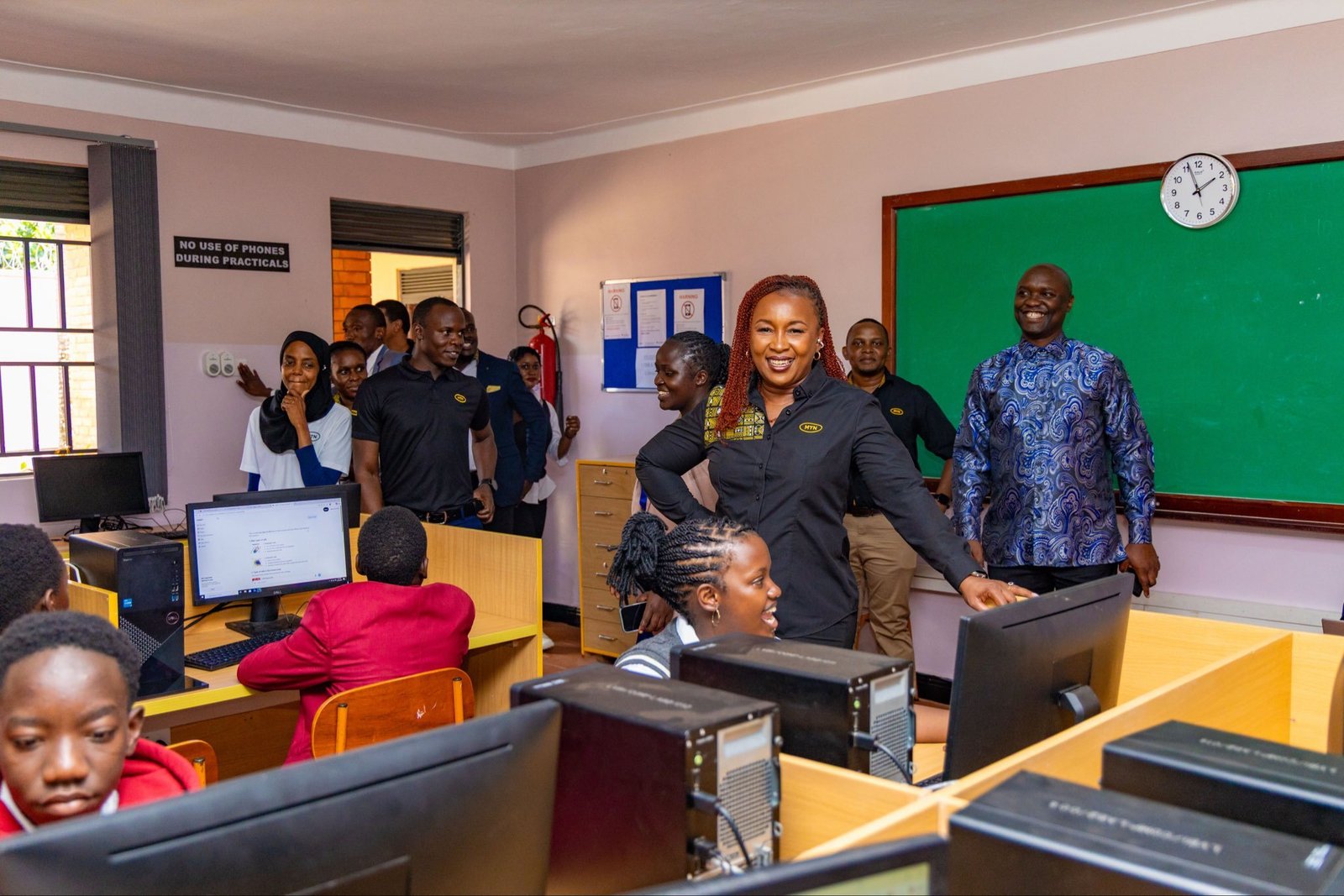
William Sekabembe, the school’s director, said previous attempts to improve connectivity, including the use of signal boosters, had failed to meet the institution’s requirements despite significant expenditure.
“Ever since we started the proof of concept with Starlink through MTN, it has really been a big milestone for us,” Sekabembe said, adding that students could conduct online research more easily and communication with parents had improved.
MTN Uganda’s Chief Executive Officer, Sylvia Mulinge, said the service would help businesses overcome geographical barriers to connectivity.
“At MTN, we believe that where you are located should not determine how far you can go,” she said.
Mulinge said customers could use satellite connectivity as their primary internet connection, as a backup to existing services or where conventional infrastructure was unavailable. The choice, he said, would depend on the organisation’s location and operational needs.
The new technology’s potential market extends beyond education to agriculture, healthcare, tourism, mining, energy, construction and humanitarian operations, where internet access can support communication between remote teams, cloud-based systems and digital service delivery.
Cost factor
But the commercial opportunity will depend on whether satellite connectivity can be delivered at a price that businesses can sustain. Equipment, installation and subscription costs may prove a barrier, particularly for smaller enterprises, while customers will need to assess the service against alternatives available in their locations.
For telecom operators, satellite partnerships offer a way to extend their reach without bearing the full cost of building terrestrial infrastructure across sparsely populated areas. They also provide another means of serving businesses whose operations depend on reliable connectivity but fall outside the commercial footprint of conventional networks.
MTN Uganda executives says the new offering forms part of its Ambition 2030 strategy to expand digital solutions across Africa. Its existing portfolio includes mobile connectivity, fibre internet and managed network services.
However, the entry of satellite technology into Uganda’s telecommunications market does not eliminate the need for conventional infrastructure.
Instead, it broadens the range of options available to businesses, with the balance between satellite, fibre and mobile connectivity likely to depend on cost, location and the demands of each operation.