




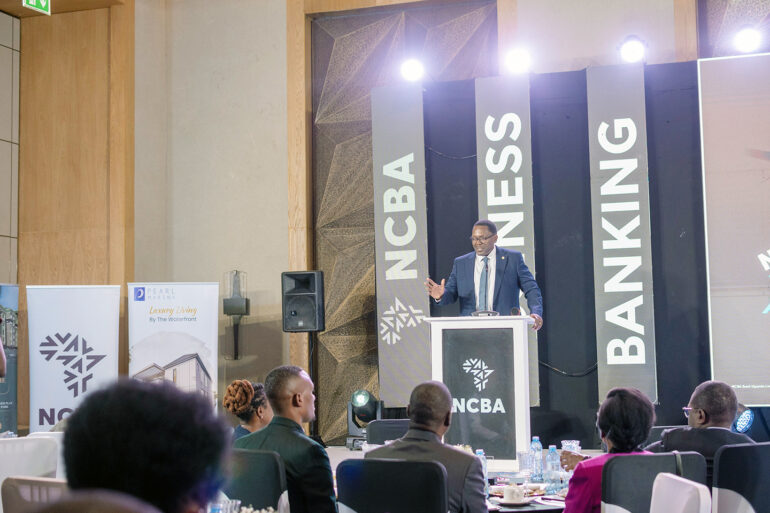
In a packed hotel hall in Kampala today, NCBA Bank Uganda pulled back the curtain on its most ambitious business banking overhaul yet, unveiling five new products alongside a campaign it calls “Ku NCBA Kiggwa Ku Bwerere.“
The timing could not be more deliberate. Uganda’s economy is riding a wave of renewed optimism, and banks are jostling for position in a sector where the difference between growth and stagnation increasingly comes down to who can get capital into entrepreneurs’ hands fastest at the best terms possible.
That urgency was evident on stage, where NCBA Bank Uganda’s Chief Executive Officer, Mark Muyobo, laid out the case for why traditional banking has not been enough.
“SMEs account for over 70% of Uganda’s private sector activity, yet many continue to face challenges including limited access to finance, cash flow constraints, and the need for digital transformation,” Muyobo said.
The Business Banking proposition offers tailored financing solutions, including unsecured invoice discounting of up to UGX 500 million, unsecured LPO financing of up to UGX 180 million, unsecured business loans of up to UGX 200 million, education finance of up to UGX 500 million, and asset financing of up to 90% of invoice value.
Customers will also benefit from free banking with zero transaction and loan arrangement fees for the next six months, as well as a commitment to receiving credit responses within 48 hours.
However, Muyobo framed the new proposition as more than a product line.
It is, he argued, a deliberate bid to widen the pool of Ugandan businesses that can invest, hire, and ultimately lift household incomes across the country.
Free banking for six months and a 48-hour credit response commitment underline a bank trying to compete on speed and accessibility rather than sheer branch count, backed by a new Enterprise Development Programme with MAT Abacus offering free mentorship in governance, tax compliance, and succession planning to business customers.
The reaction from the business community was swift and pointed.
Chief guest Abel Mwesigye, Chairman of the Kampala City Traders Association (KACITA), welcomed the launch as evidence that lenders are finally listening.
“The growth of Uganda’s private sector depends on strong partnerships and financial institutions that understand the realities of doing business,” Mwesigye said, adding that NCBA’s approach “combines accessible financing, digital innovation, and business development support to help SMEs scale sustainably.”
His comments reflect a longstanding grievance among traders: that generic loan products, built for large corporates, rarely fit the cash flow rhythms of a mid-sized trader or manufacturer.
Tailored financing, in his view, is no longer a nice-to-have but a precondition for the sector’s survival.
What happens next will test whether ambition translates into reach.
NCBA’s digital platforms, NCBA Now and ConnectPlus, promise to put approvals and cash flow monitoring in the hands of business owners without a branch visit.