



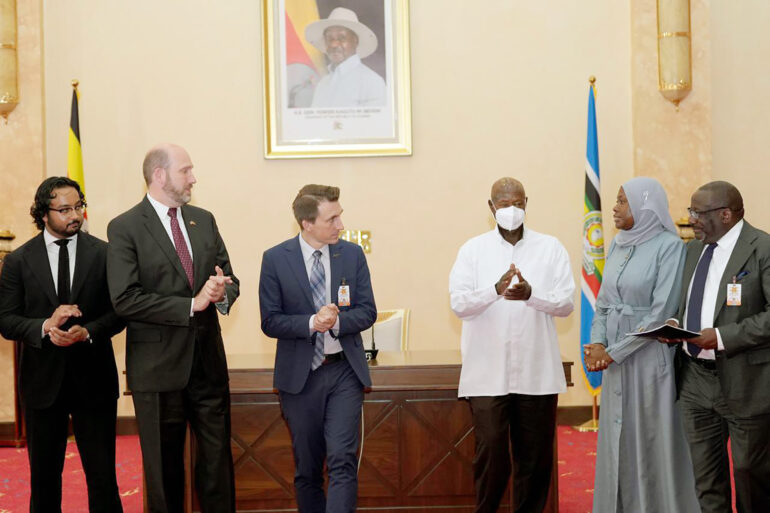
On May 15, 2026, something unusual happened at State House. President Yoweri Museveni did not just sign a routine business deal.
He witnessed a licensing agreement between the Uganda Communications Commission and Starlink. Standing beside him was the United States Ambassador to Uganda, William Popp. That detail matters. When the President and a foreign envoy attend a telecom licensing event, it signals more than commerce. It signals diplomacy, trust, and mutual interest at the highest level.
Museveni said as much on social media afterward. His tweet was measured but revealing. “Our interest is security, revenue assurance, and proper accountability within the telecommunications sector so that we know who is operating and who the customers are.”
He added that Starlink had agreed to comply with Uganda’s laws and regulatory requirements. “I wish them good luck,” he wrote.
That final line, brief and uncharacteristic of grand presidential statements, carried weight. It confirmed that a long and careful negotiation had finally concluded on terms acceptable to both sides.
The Uganda Communications Commission (UCC), the regulator of the industry, was equally deliberate in its language. In its official statement, the UCC said the agreement reflected “Uganda’s continued commitment to innovation, investment, digital inclusion, and improved access to connectivity services across the country, especially for hard-to-reach and underserved communities.” Those last words are the most important. They are not filler. They are a statement of purpose.
Uganda is a country where internet penetration remains deeply uneven. Kampala and a few urban centres have reasonable connectivity. But venture into rural Karamoja, the cattle corridors of the north, or the fishing communities on the islands of Lake Victoria, and the picture changes entirely.
Mobile signals are weak. Fibre cable is absent. Millions of Ugandans remain offline. This is not a uniquely Ugandan problem. It is the defining challenge of digital development across the continent.
Starlink’s technology addresses this problem from a different angle. Unlike conventional internet that depends on buried cables and erected towers, Starlink uses low-Earth orbit satellites.
A user needs only a clear view of the sky and a hardware kit. The signal arrives from space. Geography no longer determines access. That is a revolutionary proposition for a rural Uganda that traditional telecoms have left behind.
The Kenyan experience
The experience of Kenya, where Starlink has operated since July 2023, is instructive. Growth was rapid. Subscriptions surged nearly 2,000 percent in the first year. Rural schools, clinics, and small businesses gained reliable internet for the first time.
A partnership between Microsoft, Starlink, and local provider Mawingu Networks is now connecting 450 community hubs in rural Kenya, covering farmer cooperatives and digital learning centres. That model points toward what Uganda could achieve.
But Kenya also teaches caution. Capacity issues emerged as subscriber numbers grew. In 2024, Starlink suspended new urban subscriptions in Nairobi due to network congestion. Average speeds fell significantly. The lesson is that scaling satellite internet in a competitive market brings real pressures.
Cost remains the most stubborn barrier. The hardware kit can cost between $200 and $400. In a country where many households earn less than that per month, this is a luxury.
Monthly subscriptions, while competitive, still exclude the poorest. Starlink will not, on its own, solve Uganda’s digital divide.
Its true impact will come through schools, clinics, and community hubs, not individual households. Institutions and NGOs will likely drive early adoption. Businesses in remote areas will follow.

UCC ED Nyombi Thembo congratulates Starlink’s representative as he hands over the certificate.
Governments across Africa have been slow to license Starlink, partly because satellite internet challenges their traditional control over digital infrastructure. Some countries have used internet shutdowns as tools of political management. Satellite signals are harder to control.
The UCC’s statement on lawful interception obligations and data protection signals that Uganda has thought carefully about this. The government wants connectivity. But it also wants accountability.
That tension is not unique to Uganda. It is the defining regulatory question of the satellite internet era. Uganda’s approach, negotiating hard but ultimately reaching agreement, offers a practical template. Compliance first, then access.
Owned by US billionaire Elon Musk, the company has seen rapid growth, driven by a massive expansion in its user base, which nearly doubled to around 9 million subscribers by the end of 2025, covering over 150 markets . In early 2026, that number surpassed 10 million users.
Starlink is now licensed in 29 African countries. Uganda joins that list at a moment when the continent’s digital ambitions are intensifying. The agreement signed at State House on May 15 was not just a business milestone.
It was a statement about where Uganda intends to be in the coming decade.
The rural farmer in Soroti, the teacher in Arua, the nurse in Moroto – they may not have been in that room. But the deal was made with them in mind.