



As Pedson Mumbere reports, the numbers that Civil Aviation Authority boss Fred Bamwesigye has presented to the press are more than a statistical snapshot. They are also a warning.
The figures from the CAA are a clear indication of what happens to a landlocked, import-dependent economy when the world’s air corridors collapse.
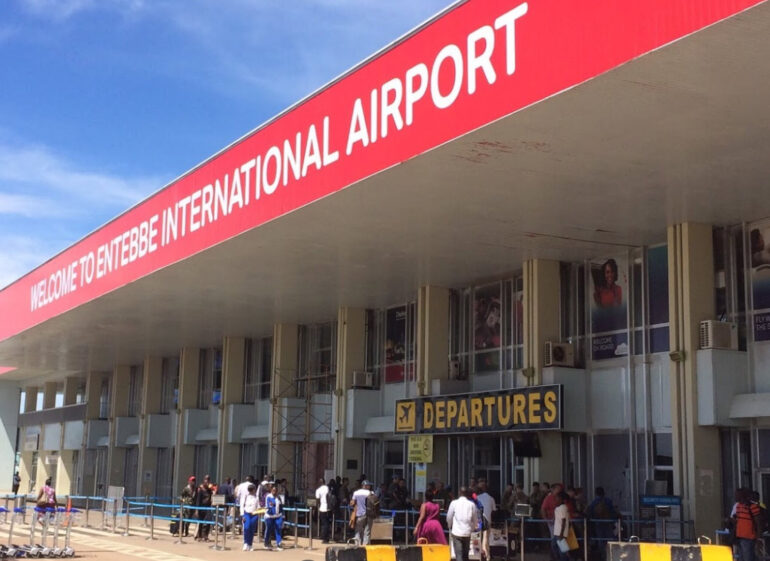
Between January and March this year, international arrivals at Entebbe International Airport dropped by 7.9 percent, departures by 8.5 percent, and cargo exports by a staggering 28.9 percent.
In March alone, cargo exports fell by 45.2 percent compared to the same month in 2025. These are not rounding errors. They are economic bruises.
The trigger was the escalation of the US-Iran conflict and the subsequent closure of airspace across parts of the Middle East beginning February 28.
The fallout was swift and systemic. Emirates, Fly Dubai, Air Arabia, Qatar Airways and Uganda Airlines all suspended or curtailed flights.
The ripple reached Kampala almost immediately, not because Uganda is part of the war, but because our aviation infrastructure is tied, often invisibly, to the hubs of Dubai in the UAE and Doha in Qatar. When those hubs buckle, we buckle with them.
To understand why this matters beyond the Entebbe airport terminals, consider what moves through the belly of those grounded planes.
Uganda’s flowers and coffee exporters in the western and central regions, fresh fish processors around Lake Victoria, all depend on cargo space aboard commercial passenger flights.
When airlines suspend routes, those goods have nowhere to go, or they go at ruinous cost. Freight rates across East Africa spiked by nearly 80 percent during this period.
For a small-scale Ugandan exporter already operating on thin margins, that is not a mere surcharge; it is extinction.
Tourism, Uganda’s second-largest foreign exchange earner, took a separate but equally serious blow.
The Uganda Tourism Board reported a sharp decline in bookings for the June-to-September peak season, the period the industry depends on most.
Some tourists were literally stranded in Uganda in early March after Emirates and Qatar Airways cancelled flights without notice, forcing the government to issue emergency visa extensions.
It is a measure of how entangled our visitor economy is with the fortunes of airlines we do not own, routes we do not control, and geopolitical events we had no hand in creating.
Global aviation decline
The broader picture is grimmer still. Globally, over 21,000 flights were cancelled in the weeks following the conflict’s escalation.
Airlines serving the Eurasian corridor had to reroute around blocked airspace, adding thousands of kilometres and tens of thousands of dollars in fuel costs per flight.
A Tokyo-to-London service now burns tens of thousands of additional dollars per journey. These costs are not absorbed by airlines. They are passed on to passengers through surcharges, and to economies through reduced connectivity.
For Africa, the crisis exposed a structural weakness that was already well known but rarely acted upon: the continent remains over-reliant on Middle Eastern super-connectors.
When Dubai and Doha close, Africa’s access to global trade and tourism corridors narrows sharply.
East African hubs like Nairobi and Addis Ababa moved quickly to reposition themselves as alternative routing points, and with some success.
Entebbe, by contrast, recorded growth in transit passengers, up 25.2 percent, suggesting the airport is being used as a waypoint even as it struggles on core traffic.
The lesson for Uganda, and for developing countries broadly, is not subtle. Aviation is not a luxury infrastructure.
It is the circulatory system of a modern trade and tourism economy. A country that cannot protect the reliability of its air links, whether through bilateral agreements, diversified airline partnerships, or a sufficiently capable national carrier, is a country whose exports can be grounded by a conflict it never chose and cannot influence.
Uganda Airlines must be part of this conversation. The national carrier faces what experts rightly calls a double-edged sword: rising demand from passengers seeking non-Middle-Eastern routes, offset by crippling fuel costs.
Getting that equation right, through strategic route planning, hedged fuel contracts and targeted government support, is not optional.
It is the work that determines whether Uganda controls its own aviation destiny or remains perpetually subject to someone else’s turbulence.
The sky, as Bamwesigye’s numbers show, is never just the sky. It is the road our flowers travel, the corridor our tourists walk, and the artery our economy cannot afford to lose.