



President Yoweri Museveni has pledged Uganda’s full support for a proposed regional oil refinery, reports Pedson Mumbere.
The facility, championed by Nigerian billionaire Aliko Dangote, could transform East Africa’s energy landscape.
Dangote visited Museveni at State Lodge Nakasero in Kampala this week. The two leaders discussed a refinery that would process 650,000 barrels of crude oil per day.
The project is estimated to cost between $15 billion and $17 billion. That is roughly UGX 62 trillion at current exchange rates. If built, it would rank among Africa’s largest industrial facilities. It would serve a regional market of more than 300 million people.
“We shall support Mr. Dangote and we are ready to buy shares in the regional refinery,” Museveni said. He described the project as essential for Africa’s industrial future. “Our goal is regional integration and industrial development,” he added.
The timing could not be more significant. East Africa currently imports most of its refined petroleum products. The region spends billions of dollars annually buying fuel from abroad. Much of that fuel is refined in the Middle East and Asia.
The ongoing conflict between the United States and Iran has sharpened the risks. Global oil supply routes face fresh disruption. Fuel prices have become increasingly volatile.
For a region that earns hard currency from oil exports, depending on imported refined fuel is a costly paradox.
Museveni has long argued against exporting raw commodities. He reiterated that position forcefully during the Kampala talks.
“We have always been against the export of unprocessed raw materials,” he said. Uganda delayed its own oil production because it first insisted on securing a refinery. That insistence now looks prescient.
Uganda holds an estimated 6.5 billion barrels of crude oil reserves. About 1.4 billion barrels are considered recoverable. Commercial production is expected to begin in 2026.
The $5 billion East African Crude Oil Pipeline is nearing completion. The 1,443-kilometre pipeline will run from Hoima to Tanzania’s port of Tanga.
Uganda is also separately developing its own 60,000-barrel-per-day refinery in Hoima. That project remains fully on track.
Museveni was clear that Uganda’s domestic refinery and the regional project are not rivals. “We have no problem supporting a broader regional refinery,” he said.
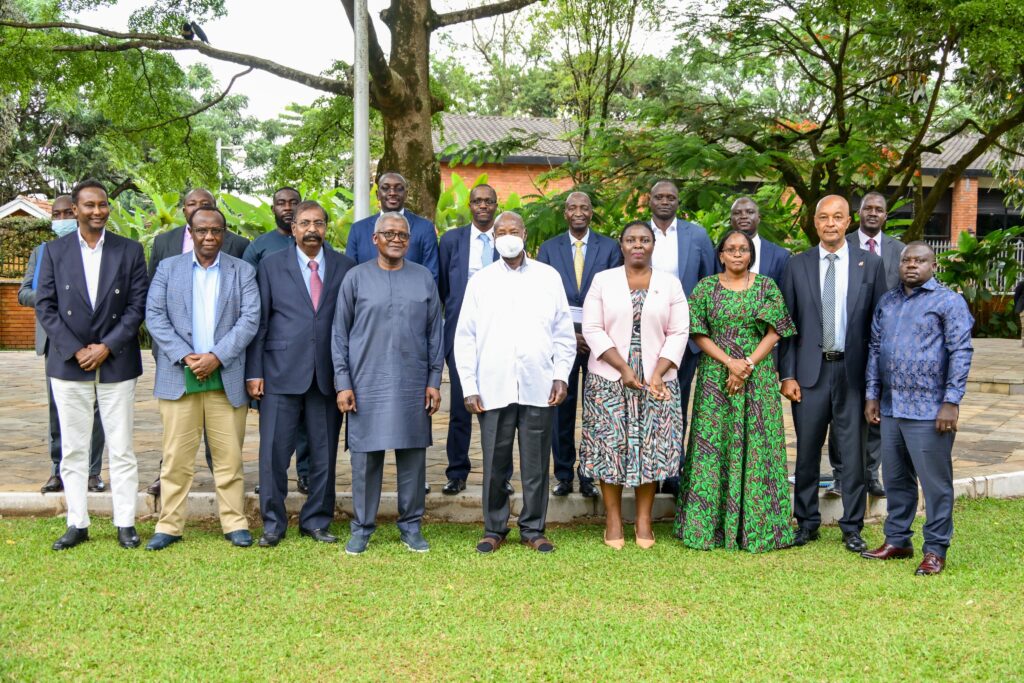
President Yowri Museveni (M) and other Governmen officials pose with Ariko Dangote (2L) and his delegation after the meeting at State House.
His energy ministry agrees. Irene Bateebe, Permanent Secretary at the Ministry of Energy and Mineral Development, described Uganda’s waxy crude as well-suited for domestic refining. Domestic fuel consumption is growing at roughly 7 percent per year.
The Dangote model for this project differs from his Nigerian operation. His Lagos refinery was privately funded. The East African venture is designed as a multi-nation public-private partnership.
Regional governments, including Uganda, are being invited to take equity stakes. That structure spreads financial risk. It also gives participating states a long-term stake in the region’s energy security.
Possible host locations include Tanga in Tanzania, and Mombasa and Lamu in Kenya. Dangote said feasibility studies are ongoing. He expects a construction period of four to five years once a location is finalised.
“This is a continuation of discussions we held with regional leaders in Nairobi,” he said. “We want to establish a refinery that can support East Africa’s growing energy needs.”
The continent’s energy gap is stark. Africa holds nearly 8 percent of the world’s proven oil reserves. Yet it accounts for less than 3 percent of global refining capacity.
East Africa’s fuel demand is projected to exceed 450,000 barrels per day by 2030. That gap represents both a vulnerability and an opportunity.
Dangote said job creation would be substantial. His Lagos refinery employs workers from multiple nationalities. East Africans, he said, would benefit similarly.
For Uganda, the opportunity is particularly layered. The country sits at the centre of this story as both a crude oil producer and a future refinery investor.
Its dual-track strategy, backing Dangote while building in Hoima, reflects a government that has learnt to hedge its energy bets wisely.