


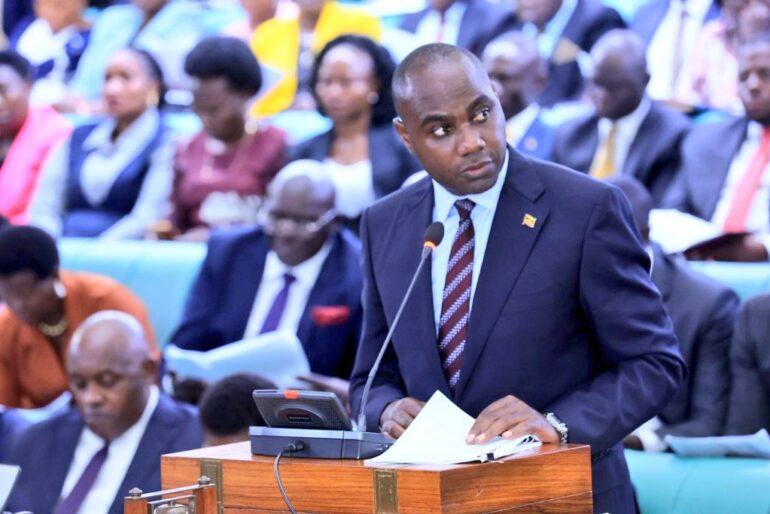
Finance Minister Henry Musasizi today steps up to the podium at Kololo Independence Grounds this morning to deliver his maiden budget speech – a UGX84.391 trillion national budget for the 2026/2027 financial year that is as ambitious as it is sobering.
The figure, a 16% jump over last year’s spending, lands Uganda on the eve of two historic milestones: the country’s first direct oil revenues and its projected graduation from Least Developed Country status in March 2027. But the numbers beneath the headline tell a more complicated story.
The budget is anchored in Uganda’s Fourth National Development Plan (NDP IV) and the government’s longer-range “Tenfold Growth Strategy,” which aims to expand the economy to $500 billion by 2040.
The overarching theme – Full Monetization of Uganda’s Economy through Commercial Agriculture, Industrialization, and related drivers – signals that government wants to pull the roughly one-third of households still locked in subsistence farming into the market economy.
The Ministry of Finance projects GDP growth of 10.4% for the coming fiscal year, up sharply from 6.3% two years ago, with nominal GDP expected to rise from UGX251 trillion to UGX290 trillion.
The financing mix deserves scrutiny. Domestic revenue is targeted at Shs 44.18 trillion – the backbone of the plan, representing more than half the total.
External project support adds Shs 11.27 trillion, with Shs 1.44 trillion arriving for the first time as direct petroleum revenue.
But Parliament’s final approved budget ballooned by UGX15 trillion above the Ministry’s initial proposal, and the shortfall was bridged almost entirely by tripling planned domestic borrowing from UGX8.95 trillion to UGX 25.7 trillion.
Fiscal conservatives and opposition MPs have warned this will crowd out private sector credit.
The concern is not abstract: banks currently lend UGX67 trillion to government versus only UGX25.4 trillion to businesses.
The priority sector allocations reflect the government’s ATMS agenda – Agro-Industrialization, Tourism, Minerals, and Science, Technology and Innovation. Infrastructure commands UGX10.8 trillion for roads, railways, water, and electricity.
Wealth creation interventions receive over UGX2.49 trillion, with UGX2.2 trillion earmarked specifically for agricultural research, irrigation, extension services, and agro-processing hubs.
Tourism gets UGX571.5 billion for park infrastructure and international marketing. Defence tops individual ministry allocations at UGX 2.976 trillion.
The single darkest number in the budget is this: UGX33.6 trillion – nearly 40% of the entire envelope – is earmarked for debt servicing, making it the largest single expenditure in Ugandan fiscal history. Interest payments alone consume UGX 12.4 trillion, driven heavily by costly domestic borrowing.
Uganda’s total public debt stock now stands at UGX126.18 trillion ($34.86 billion). The Ministry is also raising taxes aggressively to close the revenue gap, with a new top PAYE rate of 40% for incomes above UGX 10 million per month, fuel excise duty rising by UGX200 per litre, a tripled sugar tax, and a doubling of cement excise duty.
Critics note that while the PAYE hike targets high earners, the fuel, sugar, and cement levies are regressive – they push up transport costs, food prices, and the already prohibitive cost of housing in a country with a 2.4-million-unit deficit.
Of course, civil society organisations have greeted the budget with measured concern. They acknowledge it arrives at a pivotal moment and welcome the focus on wealth creation, but argue that achieving the government’s tenfold growth target must go hand in hand with equity.
Their core demand is straightforward: increase allocations to health, education, and agriculture so that the budget is truly people-first.
The Education Ministry’s own alarm is telling – its allocation for 2026/27 has been cut from a projected UGX829 billion to UGX801 billion, a move the Ministry says directly threatens human capital commitments.
Musasizi’s maiden budget, then, is a document of genuine tension. The oil revenues and LDC graduation offer a rare runway for transformation.
But with 40% of public money locked into debt service and domestic borrowing spiraling upward, the government is essentially betting that a 10.4% growth rate will validate the entire edifice.
If that growth materializes, that is,
Uganda takes a credible step toward middle-income status. If it does not, the debt obligations remain – and the taxes, cuts, and crowded credit markets that come with them will fall hardest on the people the budget is meant to serve.