



When Airtel Uganda handed over a cheque worth UGX 42.9 billion to the Uganda Communications Commission a few days ago, it was easy to file the moment away as routine regulatory compliance. It was not.
The figure represents more than a legal obligation; it is a barometer of an industry growing with quiet but consequential momentum, and a signal of what is at stake as Uganda races to close the gap between its digital ambitions and the lived reality of millions of citizens still on the margins of the internet economy.
Under the Uganda Communications Act, every licensed telecom operator is required to remit 2% of its gross annual revenues into the Uganda Communications Universal Service and Access Fund, known as UCUSAF.
The fund is the government’s primary instrument for extending voice and data connectivity to communities that the commercial logic of the market would otherwise leave behind. Schools get ICT laboratories. Health centres get internet access. Rural communities get a fighting chance at the digital economy.
Airtel’s contribution, drawn from revenues for the financial year ended December 2025, marks a notable increase from the UGX 34.8 billion the company remitted the previous year – a jump of over UGX 8 billion in a single year. The figures tell a story of expansion.
Last year, MTN Uganda, the sector’s market leader, remitted UGX 42.5 billion to a fund that is becoming an increasingly powerful lever for national development.
This remittance matters because the infrastructure gap remains real. Mobile voice coverage reaches approximately 89% of Uganda’s geographic area, but broadband coverage, while improving, still lags in meaningful use across rural communities.
The country now counts over 47 million active mobile subscriptions and more than 36 million mobile money accounts, yet device affordability, data costs and a shortage of locally relevant digital content continue to limit how much ordinary Ugandans – particularly the rural poor – can extract from a connected life.
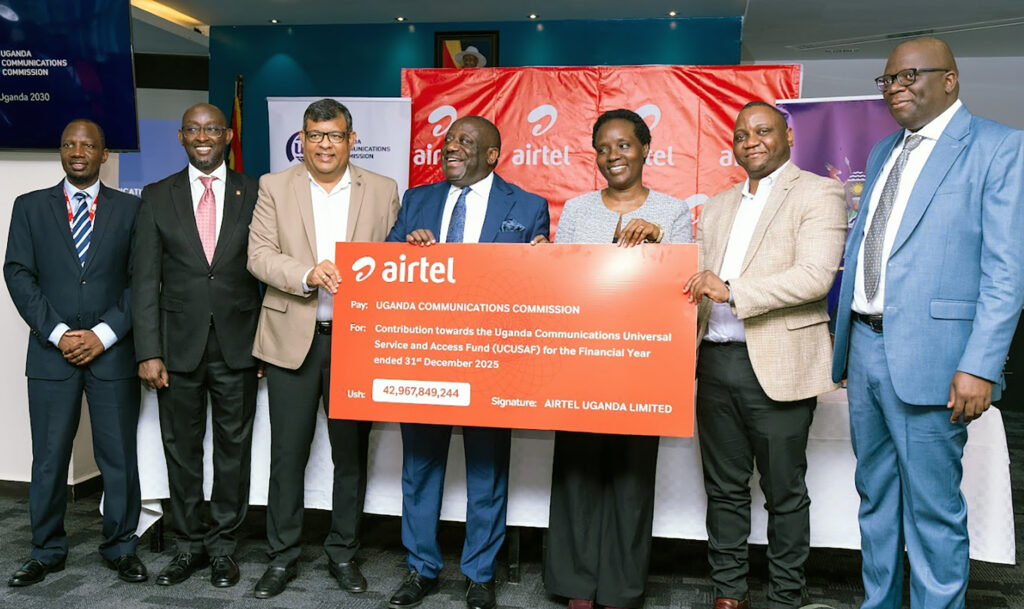
UCC ED Nyombi Thembo (M) receives the dummy cheque from Airtel Uganda officials
This is where the UCUSAF conversation becomes one about young people. Uganda is one of the youngest nations on earth.
Its population is overwhelmingly under 30, entering a job market being rapidly reshaped by automation, artificial intelligence and digital services.
Young Ugandans without digital literacy are not just inconvenienced – they are structurally excluded from entire categories of economic opportunity.
When UCUSAF finances an ICT lab in a rural school in Karamoja or Kigezi, it is not building infrastructure for its own sake.
It is giving a generation of students a passport to participate in an economy that increasingly rewards those who can navigate digital tools.
Airtel’s own investments underline the pace of change. The company added 258 new 4G sites in the past year alone and expanded its 5G footprint to 364 sites across ten major urban centres.
It has also entered testing for a Direct-to-Cell satellite technology partnership with Starlink – a development that could allow standard smartphones to connect directly to satellites in areas where no tower exists.
These are not incremental steps. They are structural changes to what connectivity looks like in Uganda.
The ICT sector now contributes an estimated 8% of GDP, with internet penetration surpassing 60% and mobile broadband subscriptions exceeding 20 million. Uganda’s Digital Vision 2040 and the UCC’s Strategic Plan through 2030 are anchored on the premise that digital infrastructure is not a luxury but a foundation for economic transformation – from digital banking to e-government, from online education to agricultural technology.
The cheque Airtel signed is, in that sense, more than money. It is a down payment on inclusion.