




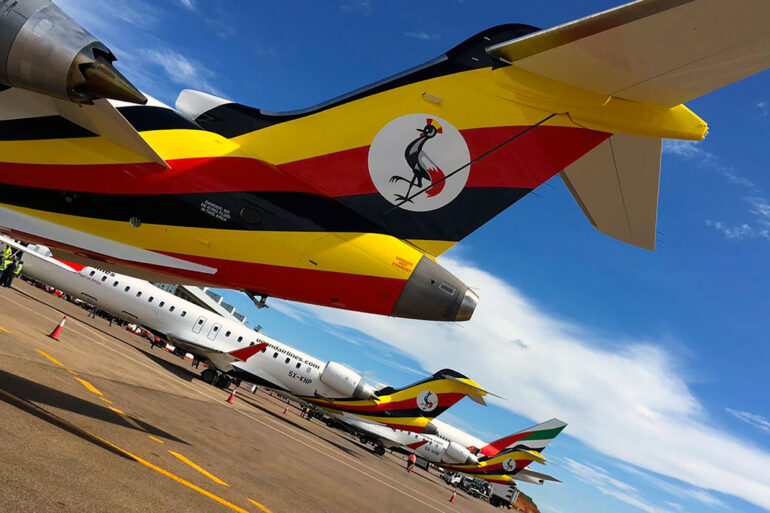
In recent years, President Yoweri Museveni has developed a penchant for witnessing the signing of memoranda of understanding between his Government and international companies.
A week ago, he did witness one of the biggest ever – the signing of a Shs3.7 trillion agreement between Uganda Airlines and American aircraft giant Boeing.
This ceremony carried weight well beyond the exchange of documents. Uganda was not simply ordering aircraft. It was making a formal declaration that its national carrier – Uganda Airlines – battered, grounded at moments, and perpetually loss-making – is now ready to grow up.
The deal covers ten Boeing aircraft: four 787-9 Dreamliners for long-haul routes, four 737 MAX jets for regional expansion, and two converted freighters — a Boeing 767 and a 737 BCF – dedicated to cargo.
An initial payment of $122 million has already been committed, funded from domestic revenue collections.
Boeing has also pledged technical support, pilot training, and assistance in establishing an Approved Maintenance Organisation within Uganda – a detail that speaks to something larger than mere fleet size.
Industry observers are calling this Uganda Airlines’ “second take-off,” and the phrase is deliberate.
The first chapter, defined by the tenure of former CEO Jennifer Bamuturaki, was a survival story: routes opened, revenue climbed from Shs28 billion in 2019 to Shs319 billion by 2024, and a London Gatwick service was launched against considerable odds.
But that era was also shadowed by procurement controversies, recurring flight cancellations, and the February 2026 crisis that grounded both A330neo jets simultaneously, forcing the airline to lease a Dreamliner from Ethiopian Airlines just to keep London flights alive.
The appointment of Girma Wake as Acting CEO – an aviation veteran whose credentials were forged at the helm of Ethiopian Airlines – signaled that the government understands the difference between managing a startup and running an airline.
A statement of intent
The Boeing deal, in this context, is as much about institutional credibility as it is about aircraft. Its scale demands financial transparency and operational discipline that the previous administration could only dream of.
Beyond the boardroom, the strategic logic of this investment is compelling.
Uganda’s high-value exports – flowers, fish, fresh produce, coffee – have long been held hostage to the unreliable “belly cargo” space on passenger jets.
Dedicated freighters change that equation fundamentally, offering the schedule reliability that cold-chain logistics and sustained international contracts require.
As Uganda deepens its participation in the African Continental Free Trade Area (AfCTA), these aircraft become arterial links, not accessories.
On the passenger side, the 787-9 Dreamliner does something no aircraft in Uganda’s current fleet can: it removes the layover.
International travelers bound for the upcoming Kidepo won’t need to reroute through Nairobi or Addis Ababa.
Paired with the development of Kabalega International Airport in Hoima and the modernisation of Entebbe, Uganda is constructing a genuine aviation ecosystem – not just a hub, but a gateway.
Works and Transport Minister Fred Byamukama put it with unusual candour:
“It is a very expensive project, but the President said we have no other option.”
Uganda cannot build a middle-income economy on borrowed connectivity.
This fleet is the infrastructure of ambition – and for the first time, it looks like Uganda Airlines has the leadership to make it fly for as long as it should.