




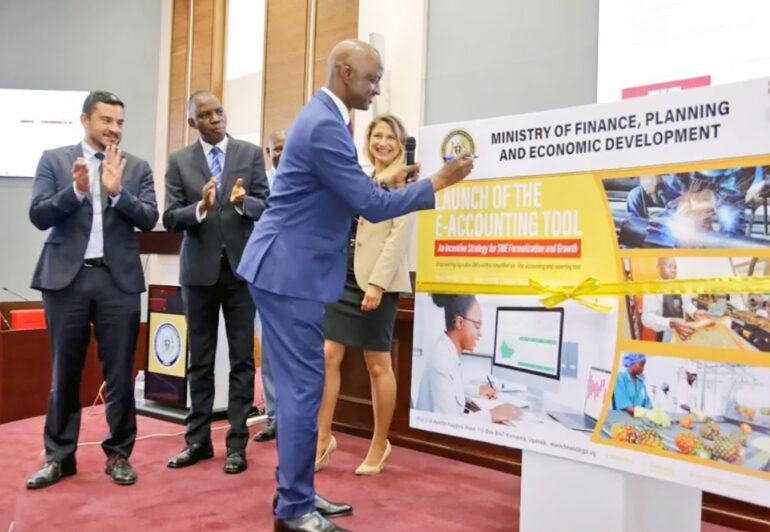
The Government has launched a simplified electronic accounting platform to help small and informal businesses improve financial record-keeping, access credit, and gradually transition into the formal economy as part of a broader strategy to strengthen economic growth and domestic revenue mobilisation. Pedson Mumbere reports.
Officially launched by Permanent Secretary and Secretary to the Treasury Ramathan Ggoobi, the platform is designed to address long-standing challenges facing small and medium enterprises (SMEs), including weak bookkeeping practices, limited tax compliance, and poor access to financing.
Developed by the United Nations Conference on Trade and Development (UNCTAD) under the Informality Management for Compliance and Revenue Mobilisation (IMCORE) Programme, the tool is part of broader efforts to modernise Uganda’s business environment through digital transformation.
Ggoobi noted that SMEs are the backbone of Uganda’s economy, contributing significantly to job creation, household incomes, and national productivity.
Uganda’s informal sector comprises more than 1.8 million micro, small and medium enterprises, many owned by women, youth, and refugees.
According to the Ministry of Finance, Planning and Economic Development, the sector contributes about 54.5% of GDP and accounts for nearly 92% of total employment.
Despite these figures, most informal businesses remain locked out of formal financial systems due to poor financial management and a lack of structured records.
“Without proper records, businesses cannot assess their performance, financial institutions cannot trust them, and tax compliance remains inconsistent,” Ggoobi said.
He emphasised that improving financial discipline among SMEs is central to achieving Uganda’s Ten-Fold Growth Strategy, which aims to expand the economy from about USD 50 billion to USD 500 billion in the coming years.
He described the platform as a “single-window solution” supporting both the legal and fiscal formalisation of small businesses.
The system allows entrepreneurs to digitally track income and expenditure, manage cash flow, generate financial statements, and monitor business performance in real time. This is expected to improve SMEs’ ability to access bank loans and other financing by providing credible financial records.
At the handover of the platform to the Ministry of Finance following successful pilot testing, Ms Elena Botvina, an Economic Affairs Officer in UNCTAD’s Division on Investment and Enterprise, said the tool was designed with simplicity and affordability in mind.
“The tool is convenient and cost-effective for record-keeping and reporting. It helps enterprises improve cash management, track expenditure, and increase revenues through better financial planning,” Ms Botvina said.
She added that the platform is expected to reduce business informality by making compliance easier and less costly for small enterprises.
Capacity Building
During the pilot phase, at least 30 informal enterprises in Kampala received hands-on training. In total, more than 490 SMEs tested the platform, and at least 241 businesses formally registered and created active accounts.
Officials say these early results demonstrate strong potential for a nationwide rollout.
The launch comes as Uganda intensifies efforts to expand its tax base by formalising informal businesses, improving productivity, and strengthening domestic revenue mobilisation to support public investment.
Economists argue that poor bookkeeping has historically constrained SME growth, limiting the ability of small businesses to attract investment, scale operations, and compete in formal markets.
Analysts note that digital accounting tools could significantly reduce informality by simplifying compliance requirements and lowering operational costs.
With Uganda’s informal sector representing a dominant share of employment and economic activity, government officials believe the new platform could become a transformative tool, upgrading micro enterprises into sustainable, tax-compliant, and investment-ready businesses capable of driving long-term economic development.