



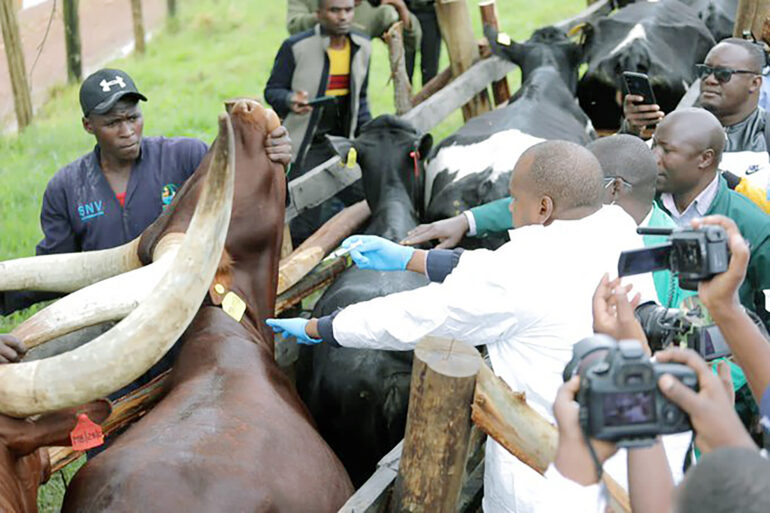
The Government has announced tougher livestock trade regulations that will bar unvaccinated animals from commercial markets as part of a nationwide strategy to control Foot-and-Mouth Disease (FMD) and protect the country’s growing livestock export sector.
Under the new policy unveiled by the Ministry of Agriculture, Animal Industry and Fisheries (MAAIF), livestock owners will be required to show proof that they vaccinated their animals against FMD before obtaining movement permits and other veterinary certifications necessary for trade.
While addressing journalists at the Uganda Media Centre, State Minister for Animal Industry Bright Rwamirama, said the measure is intended to prevent recurring disease outbreaks that have disrupted livestock production and restricted access to lucrative export markets.
“No animal will be allowed to move for trade without proof of vaccination. We are linking vaccination to market access because disease outbreaks have continued to cause significant losses to farmers and the national economy,” Rwamirama said.
Consequently, the government will implement a mandatory biannual vaccination programme covering approximately 45.5 million susceptible animals, including 16.5 million cattle, 17.4 million goats, 4.4 million sheep and 8 million pigs.
The first nationwide vaccination exercise will take place between July and August, while the second phase will be conducted between January and February each year.
The policy follows a series of FMD outbreaks between late 2023 and mid-2024 that resulted in livestock quarantines, market closures and disruptions across the livestock value chain.
To finance the programme, the government is introducing a cost-sharing model that requires farmers to contribute UGX 8,000 per vaccine dose for cattle and pigs, and UGX 4,000 per dose for goats and sheep.
Government will continue to fund vaccine administration, transportation, cold-chain management and disease surveillance activities.
Rwamirama said the previous fully subsidised vaccination programme had struggled to achieve adequate coverage due to budgetary constraints.
“We realised that relying entirely on government funding was not sustainable.
To effectively control Foot-and-Mouth Disease, we must consistently achieve high vaccination coverage, and that requires a predictable financing mechanism,” he said.
Revolving fund set up
Funds collected from farmers are to be deposited into a revolving fund managed by the Bank of Uganda to ensure continuous vaccine procurement and availability.
According to the ministry, Uganda earned more than US$385 million (approximately UGX 1.4 trillion) from dairy exports last year, up from about US$285 million (approximately UGX 1.04 trillion) previously.
Officials say controlling animal diseases remains critical to sustaining this growth and expanding access to international markets that maintain strict animal health standards.
The government has also strengthened vaccine distribution infrastructure ahead of the nationwide rollout.
MAAIF has upgraded its central vaccine storage facility in Entebbe and established 53 solar-powered district vaccine stores. A further 40 storage facilities are planned in the next financial year.
In addition, the ministry has secured 53.6 million doses of a quadrivalent vaccine designed to protect livestock against four major strains of Foot-and-Mouth Disease prevalent in the region.
The minister said preparations for the vaccination campaign are progressing well, with more than 20,000 farmers and approximately 3.5 million animals already registered under the national livestock identification and traceability system.
Agriculture stakeholders have welcomed the policy, arguing that the cost of vaccination is significantly lower than the financial losses caused by disease outbreaks.
Henry Sight Lugoloobi, Chairperson of the Uganda Best Farmers Coalition, said the vaccination fee should be viewed as an investment in protecting valuable livestock assets.
“When a cow is worth between UGX 2 million and UGX 5 million, paying UGX 8,000 for vaccination is a reasonable cost.
Farmers must recognise that disease control is a shared responsibility,” Lugoloobi said.