




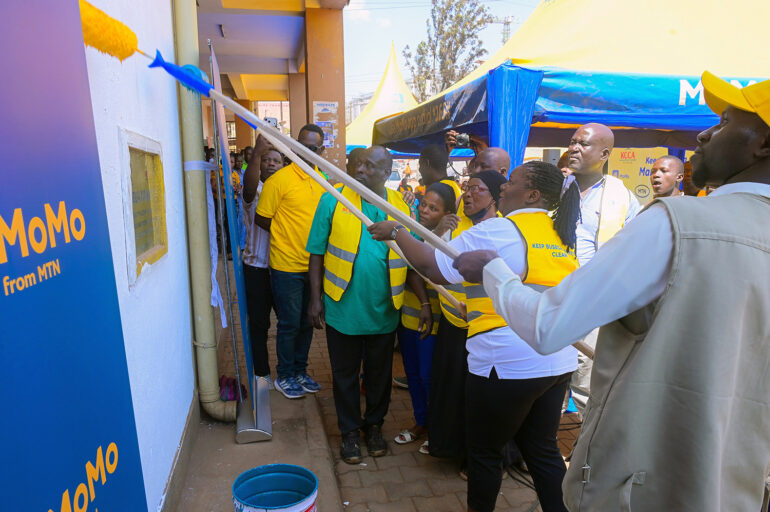
Early this morning, something unusual happened at Busega, one of Kampala’s most chaotic trading points – it got cleaned.
Not by overworked and underpaid city cleaners, but by a coalition of MTN Mobile Money staff, KCCA officials, market traders, and transport operators — all pulling in the same direction.
The clean-up, which preceded the formal launch of a joint urban transformation initiative, was modest in spectacle but significant in what it signals about the evolving role of Uganda’s corporate sector in public life.
The initiative extends beyond Busega Market to five of Kampala’s busiest transport parks — Busega, Kisenyi, Kalerwe, Namayiba, and Natete – spaces that collectively represent the nervous system of the city’s daily economy.
Thousands of Ugandans pass through these hubs every day: hawkers, commuters, boda riders, conductors, and small traders whose livelihoods depend entirely on the functionality of these spaces.
Yet for years, they have operated in conditions that are overcrowded, unsanitary, and in many cases unsafe.
Of course, the market does not wait for better infrastructure; people simply adapt and endure.
That endurance has a cost. Disorganised trading environments suppress productivity, discourage formal business registration, and create public health risks that fall disproportionately on low-income workers.
Bus and taxi parks, meanwhile, are not merely transit points – they are economic ecosystems where informal employment, supply chains, and social networks intersect. Improving these spaces is not charity.
It is investment in the infrastructure of Uganda’s real economy.
MTN MoMo’s decision to anchor this initiative reflects a broader corporate philosophy that has distinguished the company in Uganda’s ESG landscape.
In recent months, MTN Uganda has demonstrated a consistency that separates genuine social investment from seasonal philanthropy: establishing ICT resource centres in KCCA public libraries, supporting city cleaners with food hampers, and now committing to the physical revitalisation of commercial and transport infrastructure.
These have formed a coherent pattern of engagement with the structural challenges that define urban Ugandan life.
Carolyn Nabunya, MTN MoMo’s Senior Manager for Commercial Operations, framed it plainly: markets and transport hubs are where businesses grow and livelihoods are built.
The company’s parallel push to encourage cashless transactions within these spaces adds a practical layer to the initiative – cleaner environments paired with digital financial tools create conditions where commerce can become more secure, traceable, and inclusive.
The deeper lesson here is about the model itself. KCCA carries a mandate too large for public resources alone.
Uganda’s urban growth is outpacing infrastructure, and the gap between what city authorities can deliver and what residents need is widening.
Partnerships like this one – where private capital, digital infrastructure, and institutional authority converge around a shared objective – represent perhaps the most viable path to closing that gap.
What began with brooms and bin bags in Busega is, in truth, a template worth watching and emulating by other corporate entities.