




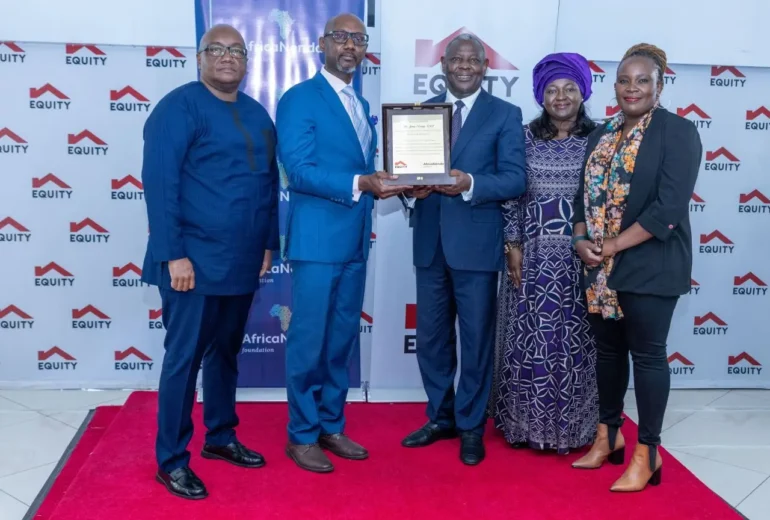
In a Nairobi boardroom on July 6, three institutions signed an agreement that could quietly reshape how hundreds of millions of Africans send money, prove who they are, and access government services.
Equity Group Holdings, the AfricaNenda Foundation, and the Gates Foundation have entered a strategic partnership to accelerate Digital Public Infrastructure, or DPI, across the continent, and Equity’s Group Managing Director and CEO, Dr. James Mwangi, was named the first Continental DPI Champion, a recognition of his role in advancing inclusive digital finance.
Evidently, the stakes are larger than one signing ceremony suggests.
Nearly 400 million Africans remain outside formal financial services, a gap that persists even after a decade of mobile money expansion.
“Through this partnership, we want to build practical Digital Public Infrastructure models and scale them across 20 to 30 African markets,” said Dr. Robert Ochola, AfricaNenda’s Chief Executive Officer, framing the collaboration as a bridge from policy to implementation.
“Digital Public Infrastructure cannot succeed without private-sector participation,” he added, noting that Equity brings execution capability and market reach that policy alone cannot supply.
East Africa sits at the centre of this agenda. Equity Group’s financial services footprint runs deep across the region, and AfricaNenda already works with more than 30 central banks, including those of Rwanda and South Sudan.
Uganda itself offers an instructive case. The country has pushed financial inclusion to 81 percent by 2023, largely on the back of mobile money.
Yet that success masks a stubborn problem: banks, mobile money operators, and fintechs still operate in silos, and moving value between them remains costly and clumsy for ordinary users and small traders alike.
Interoperable payment systems, the core promise of DPI, would let these platforms talk to one another, cutting friction and cost for the people who can least afford either.
Mobile money also stopped short of solving credit and savings. Millions of Ugandans, particularly women and rural small-scale entrepreneurs, remain invisible to formal lenders because their financial histories live inside SACCOs and Village Savings and Loans Associations rather than national credit bureaus.
Folding that data into shared infrastructure could open growth capital and insurance to borrowers that banks currently cannot see.
There is a regional dimension too: as the region integrates into the African Continental Free Trade Area, unified digital payment rails would shorten and cheapen cross-border trade for SMEs, while Uganda’s existing national ID system offers a foundation for the “trusted identity” layer DPI requires, easing fraud checks and KYC processes.
Dr. Mwangi described the partnership as consistent with Equity’s founding mission of transforming lives through inclusion, while Nanjira Sambuli from the Gates Foundation offered the sharpest caution of the day.
“Building Digital Public Infrastructure is only a first step,” she said.
“The real measure of success is whether people use it to improve their lives.”
That line sets the true test for this initiative, in the region and across the continent: not how sophisticated the plumbing becomes, but whether a market trader in Mukono or a saver in a rural SACCO in Rukiga ever notices the difference.